

Question 51
A company's latest accounts show profit after tax of $20.0 million, after deducting interest of $5.0 million. The company expects earnings to grow at 5% per annum indefinitely.
The company has estimated its cost of equity at 12%, which is included in the company WACC of 10%.
Assuming that profit after tax is equivalent to cash flows, what is the value of the equity capital?
Give your answer to the nearest $ million.
$ ? million
The company has estimated its cost of equity at 12%, which is included in the company WACC of 10%.
Assuming that profit after tax is equivalent to cash flows, what is the value of the equity capital?
Give your answer to the nearest $ million.
$ ? million
Question 52
Company HJK is planning to bid for listed company BNM
Financial data for BNM for the financial year ended 31 December 20X1:
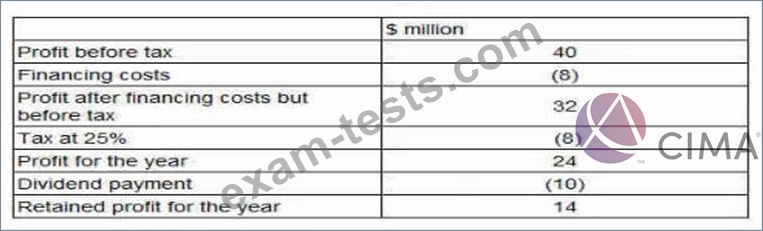
HJK is not forecasting any growth in these figures for the foreseeable future Profit and cost data above should be assumed to be equivalent to cash flow data when answenng this question Which THREE of the following approaches would be most appropriate for HJK to use to value the equity of BNM?
Financial data for BNM for the financial year ended 31 December 20X1:
HJK is not forecasting any growth in these figures for the foreseeable future Profit and cost data above should be assumed to be equivalent to cash flow data when answenng this question Which THREE of the following approaches would be most appropriate for HJK to use to value the equity of BNM?
Question 53
STU has relatively few tangible assets and is dependent for profits and growth on the high-value individuals it employs. Which of the following statements best explains why the net asset valuator method's considered unstable for TU?
Question 54
A company has forecast the following results for the next financial year:
The following is also relevant:
* Profit after tax for the year can be assumed to be equivalent to free cash flow for the year.
* Debt finance comprises a $10 million floating rate loan which currently carries an interest rate of 5%.
* $400,000 investment in non-current assets is required to achieve required growth, all of which is to financed from next year's free cash flow.
* The company plans to pay a dividend of $150,000 next year, financed from next year's free cash flow.
The company is concerned that interest rates could rise next year to 6% which could then affect their investment plans.

If interest rates were to rise to 6% and the company wishes to maintain its dividend amount, the planned investment expenditure will decrease by:
The following is also relevant:
* Profit after tax for the year can be assumed to be equivalent to free cash flow for the year.
* Debt finance comprises a $10 million floating rate loan which currently carries an interest rate of 5%.
* $400,000 investment in non-current assets is required to achieve required growth, all of which is to financed from next year's free cash flow.
* The company plans to pay a dividend of $150,000 next year, financed from next year's free cash flow.
The company is concerned that interest rates could rise next year to 6% which could then affect their investment plans.
If interest rates were to rise to 6% and the company wishes to maintain its dividend amount, the planned investment expenditure will decrease by:
Question 55
Company A plans to acquire Company B in a 1-for-1 share exchange.
Pre-acquisition information is as follows:
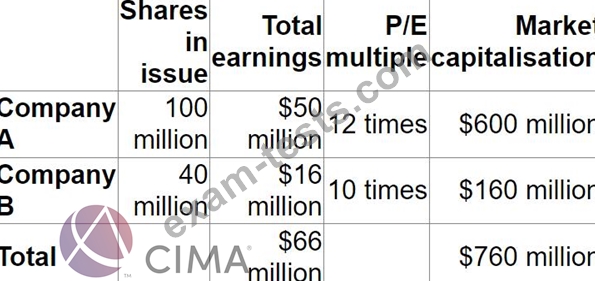
Post-acquisition information is as follows:
Annual earnings are expected to increase by $4 million.
The P/E multiple of the combined company is expected to be 12 times.
If the acquisition proceeds, what is the expected percentage increase in the post acquisition share price of Company A?
Pre-acquisition information is as follows:
Post-acquisition information is as follows:
Annual earnings are expected to increase by $4 million.
The P/E multiple of the combined company is expected to be 12 times.
If the acquisition proceeds, what is the expected percentage increase in the post acquisition share price of Company A?