Question 26
A company generates operating profit of $17.2 million, and incurs finance costs of $5.7 million.
It plans to increase interest cover to a multiple of 5-to-1 by raising funds from shareholders to repay some existing debt. The pre-tax cost of debt is fixed at 5%, and the refinancing will not affect this.
Assuming no change in operating profit, what amount must be raised from shareholders?
Give your answer in $ millions to the nearest one decimal place.
It plans to increase interest cover to a multiple of 5-to-1 by raising funds from shareholders to repay some existing debt. The pre-tax cost of debt is fixed at 5%, and the refinancing will not affect this.
Assuming no change in operating profit, what amount must be raised from shareholders?
Give your answer in $ millions to the nearest one decimal place.
Question 27
A company is planning a new share issue.
The funds raised will be used to repay debt on which it is currently paying a high interest rate.
Operating profit and dividends are expected to remain unchanged in the near future.
If the share issue is implemented, which THREE of the following are most likely to increase?
The funds raised will be used to repay debt on which it is currently paying a high interest rate.
Operating profit and dividends are expected to remain unchanged in the near future.
If the share issue is implemented, which THREE of the following are most likely to increase?
Question 28
Company A is unlisted and all-equity financed. It is trying to estimate its cost of equity.
The following information relates to another company, Company B, which operates in the same industry as Company A and has similar business risk:
Equity beta = 1.6
Debt:equity ratio 40:60
The rate of corporate income tax is 20%.
The expected premium on the market portfolio is 7% and the risk-free rate is 5%.
What is the estimated cost of equity for Company A?
Give your answer to one decimal place.
? %
The following information relates to another company, Company B, which operates in the same industry as Company A and has similar business risk:
Equity beta = 1.6
Debt:equity ratio 40:60
The rate of corporate income tax is 20%.
The expected premium on the market portfolio is 7% and the risk-free rate is 5%.
What is the estimated cost of equity for Company A?
Give your answer to one decimal place.
? %
Question 29
Company R is a major food retailer. It wishes to acquire Company S, a food manufacturer.
Company S currently supplies many stores owned by Company R with food products that it manufactures.
Company S is of similar size to Company R but has a lower credit rating.
Which of the following is most likely to be a synergistic benefit to R on purchasing S?
Company S currently supplies many stores owned by Company R with food products that it manufactures.
Company S is of similar size to Company R but has a lower credit rating.
Which of the following is most likely to be a synergistic benefit to R on purchasing S?
Question 30
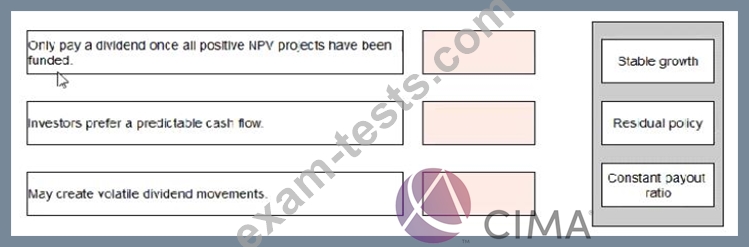
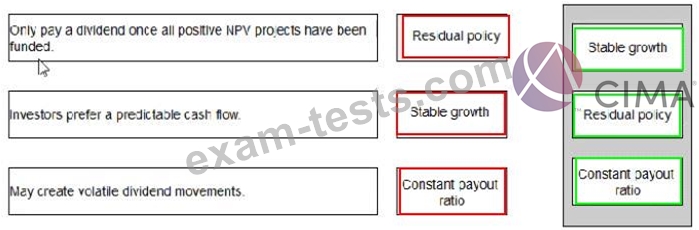
Select the most appropriate divided for each of the following statements: