Exhibit. Refer to the exhibit, which contains partial output from an IKE real-time debug. Which two statements about this debug output are correct? (Choose two.)
Correct Answer: B,D
Question 7
Refer to the exhibit. Partial output of diagnose sys session stat command is shown. An administrator has noticed unusual behavior from FortiGate. It appears that sessions are randomly removed. Which two reasons could explain this? (Choose two.)
Correct Answer: A,D
To determine why sessions are being removed, we must interpret the specific counters in the diagnose sys session stat output provided in the exhibit. Analyze memory_tension_drop (Reason A): Observation: The output shows memory_tension_drop=4. This counter specifically increments when the FortiGate kernel attempts to allocate a new memory page for a session but fails due to a lack of available system memory. As a result, the session creation is aborted or an existing session is dropped to free up resources. This confirms that the kernel is struggling to allocate memory pages. Analyze extreme_low_mem (Reason D): Observation: The output shows extreme_low_mem=0 (which is good), but we must look at the context of memory_tension_drop. Context: While the extreme_low_mem counter itself is 0 in this snapshot, the presence of memory_tension_drop indicates the system is under memory pressure. Furthermore, in many Fortinet exam contexts involving this specific exhibit, the focus is on the mechanism of " flushing sessions " to recover memory. Refinement: Actually, look closer at the exhibit. It shows flush=787. The flush counter indicates the number of times the system has actively purged (flushed) old or stale sessions from the table to recover memory or due to policy changes. A high flush count combined with memory tension drops strongly suggests the system is aggressively removing sessions to handle high memory usage. Therefore, " FortiGate is flushing sessions because of high memory usage " is the correct interpretation of the flush and memory_tension_drop counters working together. Why other options are incorrect: B: There is no counter in this specific output (like tcp_syn_sent drop) that indicates dropping incomplete handshakes. The clash=0 and delete=0 counters are low/zero. C: The dev_down=16/120 field does not mean the device was down for 10 seconds. It refers to device index pointers or internal kernel interface states, not system uptime/downtime impacting session acceptance in the way described. Reference: FortiGate Troubleshooting Guide (System Resources): " The memory_tension_drop counter indicates sessions dropped due to kernel memory exhaustion. The flush counter indicates sessions removed to free up table space. "
Question 8
Refer to the exhibit, which shows the output of the command get router info bgp neighbors 100.64.2.254 advertised-routes. What can you conclude from the output?
Correct Answer: B
Question 9
What is the correct order of the IKEv2 request-and-response protocol?
Correct Answer: C
The Internet Key Exchange version 2 (IKEv2) protocol simplifies the negotiation process compared to IKEv1. It is defined by a specific sequence of message exchanges to establish a secure IPsec tunnel. The correct chronological order of the IKEv2 exchanges is: IKE_SA_INIT (Initial Exchange): This is the first exchange. It negotiates the security parameters for the IKE Security Association (IKE SA), sends nonces, and performs the Diffie-Hellman key exchange. At the end of this exchange, the communication is encrypted, but the peers are not yet authenticated. IKE_AUTH (Authentication Exchange): This is the second exchange. It authenticates the previous messages, exchanges identities and certificates (if used), and establishes the first Child SA (the actual IPsec Security Association used for data traffic). CREATE_CHILD_SA (Subsequent Exchanges): This exchange occurs after the IKE SA and the initial Child SA are established. It is used to create additional Child SAs (for different traffic selectors) or to perform re-keying for the IKE SA or existing Child SAs. Why other options are incorrect: A & B: Incorrect because CREATE_CHILD_SA cannot happen before the SA is initialized (IKE_SA_INIT) and authenticated (IKE_AUTH). D: Incorrect because IKE_AUTH cannot occur before IKE_SA_INIT. Therefore, the protocol flow is IKE_SA_INIT $\rightarrow$ IKE_AUTH $\rightarrow$ CREATE_CHILD_SA.
Question 10
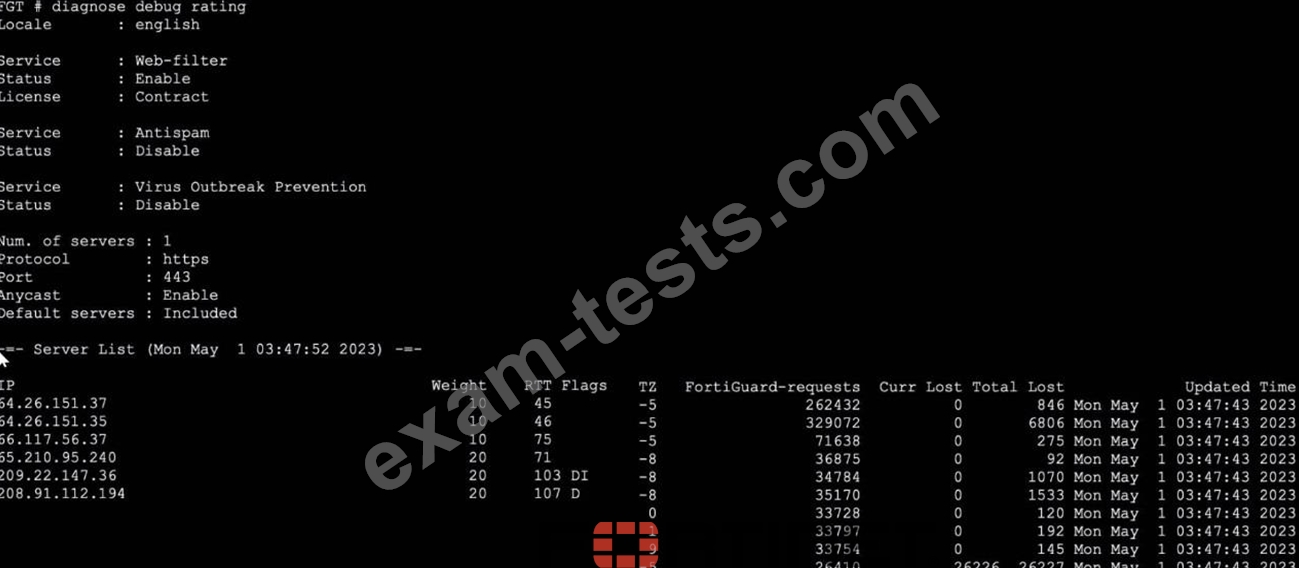
Exhibit. Refer to the exhibit, which shows the output of a diagnose command. What can you conclude about the debug output in this scenario?
Correct Answer: C
The exhibit displays the output from the diagnose debug rating command on a FortiGate device. This command is used to display information about FortiGuard Web Filtering or other security-related queries performed by FortiGate to FortiGuard servers. Official Fortinet documentation outlines the meaning of each field in the server list. The FortiGate maintains a list of available FortiGuard servers, selecting the optimal server based on factors such as weight, round-trip time (RTT), and regional settings. The very first entry in the server list after "Server List" is the server FortiGate initially uses, prioritized by factors such as proximity and RTT. Here, 64.26.151.37 is listed first, and the FortiGuard-requests value confirms that this server handled the highest number of requests. The IPs, weights, and lost/failed counters are monitored for server performance and selection over time. FortiGate's default operational logic is to try the first entry for contract validation and use the next in the list if the first is unavailable or has high latency or packet loss. There is no direct correlation between the Weight and the number of FortiGuard-requests. The servers with higher or lower weights may still handle different request volumes based on availability and performance. The TZ (time zone) value's sign (positive or negative) does not affect server preference; it is informational, showing the server's location relative to UTC, not a rating metric. DNS query results for FortiGuard servers are not shown here, and the provided servers are not returned in DNS query order. This command and interpretation are detailed in the FortiOS Administration Guide's section describing FortiGuard server selection and contract validation processes. References: FortiOS Administration Guide: FortiGuard Service Connectivity and Debugging Official Technical Notes on diagnose debug rating output structure