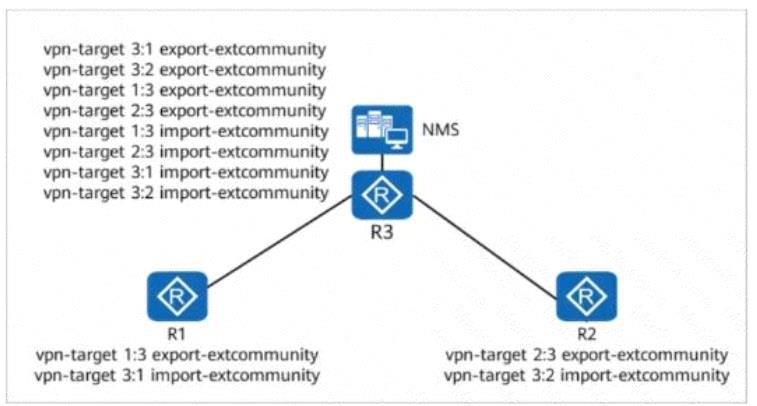
On the enterprise network shown in the figure, R3 is connected to the NMS, and all devices on the network communicate with the NMS through a VPN. During an inspection, it is found that R3 has redundant RTs (Route Targets). Which of the following commands can be run on R3 to delete the redundant RTs without affecting the connectivity between all devices and the NMS? Options:
Correct Answer: B,D
Comprehensive and Detailed In-Depth Explanation: 1. Understanding VPN Route Targets (RTs) in MPLS VPNs * Route Targets (RTs) define which VPN routes should be imported and exported among PE routers. * Import-extcommunity: Specifies which VPN routes should be accepted into a VRF. * Export-extcommunity: Specifies which VPN routes should be advertised from a VRF. * Correctly configuring RTs ensures proper route exchange between VPN sites. 2. Analyzing the RTs in the Diagram R3's Current Configuration: plaintext CopyEdit vpn-target 3:1 export-extcommunity vpn-target 3:2 export-extcommunity vpn-target 1:3 export-extcommunity vpn-target 1:3 import-extcommunity vpn-target 3:1 import-extcommunity vpn-target 3:2 import-extcommunity R1's Configuration: plaintext CopyEdit vpn-target 1:3 export-extcommunity vpn-target 3:1 import-extcommunity R2's Configuration: plaintext CopyEdit vpn-target 2:3 export-extcommunity vpn-target 3:2 import-extcommunity * R3 has redundant RTs because it both exports and imports unnecessary RTs. * We need to remove only redundant RTs without affecting NMS connectivity. 3. Evaluating Each Answer Choice A: "undo vpn-target 3:1 import-extcommunity" (# Incorrect) * R1 exports RT 1:3, and R3 imports it as 3:1. * Removing 3:1 import-extcommunity would block R3 from receiving routes from R1, disrupting connectivity to NMS. * Thus, this option is incorrect. B: "undo vpn-target 1:3 export-extcommunity" (# Correct) * R3 exports RT 1:3, but there is no need for R3 to advertise routes with 1:3. * R1 already exports 1:3, and R3 only needs to import it. * Removing vpn-target 1:3 export-extcommunity does not affect connectivity but eliminates redundancy. * # This is a correct choice. C: "undo vpn-target 1:3 import-extcommunity" (# Incorrect) * R3 needs to import 1:3 to receive routes from R1 (which is required for NMS communication). * If removed, R3 will not receive necessary routes, breaking connectivity. * Thus, this option is incorrect. D: "undo vpn-target 2:3 export-extcommunity" (# Correct) * R2 exports RT 2:3, but R3 does not need to receive it. * This RT is redundant and can be removed without affecting connectivity. * # This is a correct choice. 4. Evaluating the Answer Choices Option Correct? Reasoning A # Incorrect R3 must import 3:1 from R1 to maintain connectivity. B # Correct Removing export-extcommunity 1:3 eliminates redundancy without affecting connectivity. C # Incorrect Removing import-extcommunity 1:3 would block R3 from receiving necessary routes. D # Correct Removing export-extcommunity 2:3 eliminates redundancy without affecting connectivity. # Correct answer: B and D. Final Conclusion: * Route Targets (RTs) are used in MPLS VPNs to control route import/export policies. * R3 has redundant RTs, and removing unnecessary exports (1:3 and 2:3) optimizes configuration. * Correct commands to remove redundancy without affecting connectivity are: * # undo vpn-target 1:3 export-extcommunity * # undo vpn-target 2:3 export-extcommunity * Thus, the correct answer is: B and D.
Question 23
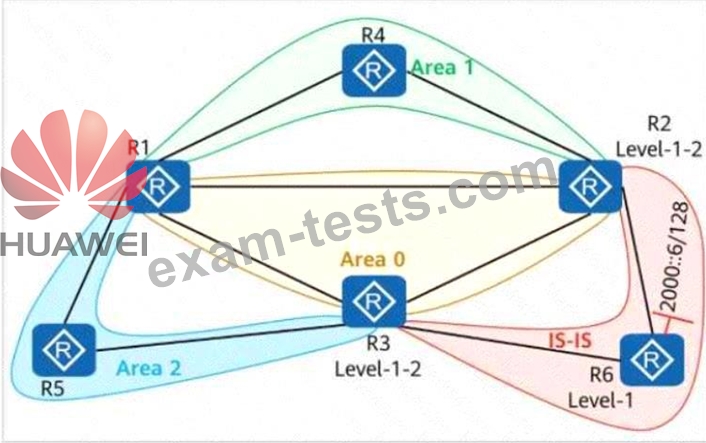
On the network shown in the figure, IS-IS IPv6 runs on R2, R6, and R3, and the IPv6 address of Loopback0 on R6 is 2000::6/128. OSPFv3 runs on other links. Area 1 is a stub area, and Area 2 is an NSSA. IS-IS routes are imported to OSPFv3 on R2 and R3. Which of the following statements are true?
Correct Answer: B,C,D
Comprehensive and Detailed In-Depth Explanation: To analyze the correct answer, we need to break down the topology and protocol behaviors step by step: * Understanding the IS-IS and OSPFv3 Network Setup: * IS-IS IPv6 is running between R2, R6, and R3. * OSPFv3 is running on other links. * Area 1 is a stub area, which means it does not accept external routes but can have a default route (::/0). * Area 2 is an NSSA (Not-So-Stubby Area), meaning it allows external routes as NSSA external LSAs. * Analysis of Each Answer Option: A: "The routing table of R6 contains the route ::/0." # FALSE * R6 only participates in IS-IS (Level-1) and does not receive a default route (::/0) from Level- 2 routers. * Since R6 is in IS-IS Level-1 and does not have a connection to a Level-2 router that provides a default route, it will not have a ::/0 route in its routing table.
Question 24
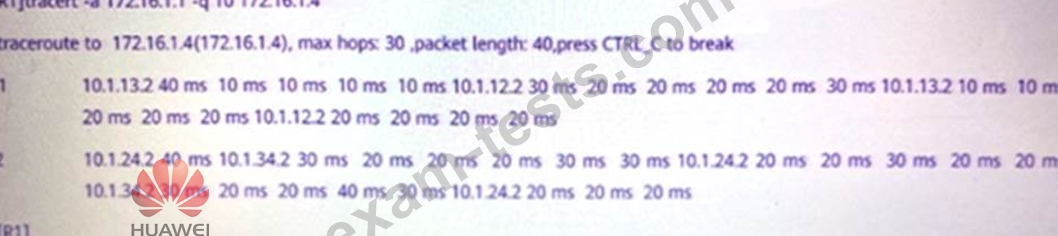
According to this picture, what can we judge? (Multiple choice)
Correct Answer: A,C
Question 25
Because BGP is the EGP routing protocol, BGP routing policies can only be deployed between EBGP neighbors. Routing policies deployed between IBGP neighbors are invalid.