
- Home
- PECB Certification
- ISO-IEC-27001-Lead-Auditor Exam
- PECB.ISO-IEC-27001-Lead-Auditor.v2025-07-30.q306 Practice Test

Question 26
You are an experienced ISMS audit team leader providing instruction to an auditor in training. They are unclear in their understanding of risk processes and ask you to provide them with an example of each of the processes detailed below.
Match each of the descriptions provided to one of the following risk management processes.
To complete the table click on the blank section you want to complete so that it is highlighted in red, and then click on the applicable text from the options below. Alternatively, you may drag and drop each option to the appropriate blank section.
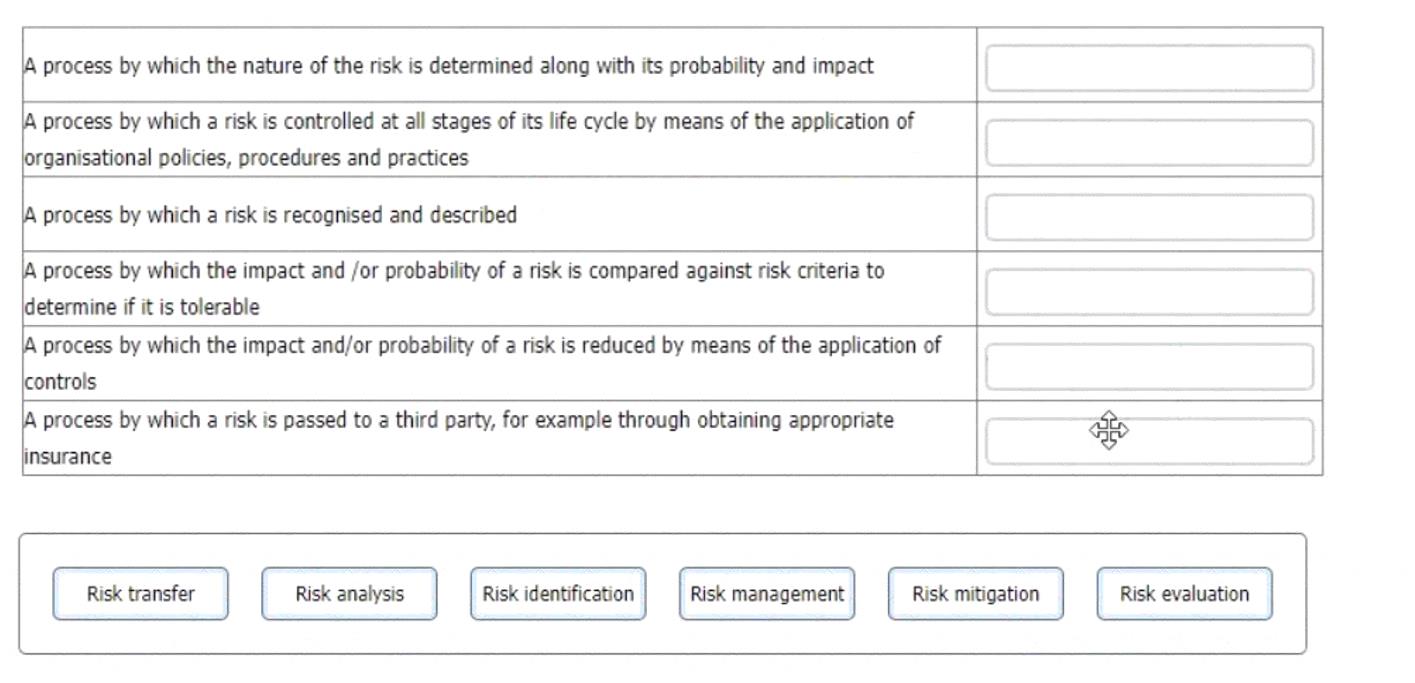
Match each of the descriptions provided to one of the following risk management processes.
To complete the table click on the blank section you want to complete so that it is highlighted in red, and then click on the applicable text from the options below. Alternatively, you may drag and drop each option to the appropriate blank section.
Correct Answer:

Explanation

Risk analysis is the process by which the nature of the risk is determined along with its probability and impact. Risk analysis involves estimating the likelihood and consequences of potential events or situations that could affect the organization's information security objectives or requirements12. Risk analysis could use qualitative or quantitative methods, or a combination of both12.
Risk management is the process by which a risk is controlled at all stages of its life cycle by means of the application of organisational policies, procedures and practices. Risk management involves establishing the context, identifying, analyzing, evaluating, treating, monitoring, and reviewing the risks that could affect the organization's information security performance or compliance12. Risk management aims to ensure that risks are identified and treated in a timely and effective manner, and that opportunities for improvement are exploited12.
Risk identification is the process by which a risk is recognised and described. Risk identification involves identifying and documenting the sources, causes, events, scenarios, and potential impacts of risks that could affect the organization's information security objectives or requirements12. Risk identification could use various techniques, such as brainstorming, interviews, checklists, surveys, or historical data12.
Risk evaluation is the process by which the impact and/or probability of a risk is compared against risk criteria to determine if it is tolerable. Risk evaluation involves comparing the results of risk analysis with predefined criteria that reflect the organization's risk appetite, tolerance, or acceptance12. Risk evaluation could use various methods, such as ranking, scoring, or matrix12. Risk evaluation helps to prioritize and decide on the appropriate risk treatment options12.
Risk mitigation is the process by which the impact and/or probability of a risk is reduced by means of the application of controls. Risk mitigation involves selecting and implementing measures that are designed to prevent, reduce, transfer, or accept risks that could affect the organization's information security objectives or requirements12. Risk mitigation could include various types of controls, such as technical, organizational, legal, or physical12. Risk mitigation should be based on a cost-benefit analysis and a residual risk assessment12.
Risk transfer is the process by which a risk is passed to a third party, for example through obtaining appropriate insurance. Risk transfer involves sharing or shifting some or all of the responsibility or liability for a risk to another party that has more capacity or capability to manage it12. Risk transfer could include various methods, such as contracts, agreements, partnerships, outsourcing, or insurance12. Risk transfer should not be used as a substitute for effective risk management within the organization12.
References :=
ISO/IEC 27001:2022 Information technology - Security techniques - Information security management systems - Requirements ISO/IEC 27005:2022 Information technology - Security techniques - Information security risk management
Question 27
A decent visitor is roaming around without visitor's ID. As an employee you should do the following, except:
Correct Answer: A
As an employee, you should do the following when you see a visitor roaming around without visitor's ID, except saying "hi" and offering coffee. Saying "hi" and offering coffee is not an appropriate action, as it may imply that you are welcoming or endorsing the visitor without verifying their identity or purpose. This may also give the visitor an opportunity to gain your trust or exploit your kindness. Calling the receptionist and informing about the visitor is an appropriate action, as it alerts the responsible staff to handle the situation and ensure that the visitor is authorized and registered. Greeting and asking him what is his business is an appropriate action, as it shows your concern and curiosity about the visitor's presence and intention. Escorting him to his destination is an appropriate action, as it prevents the visitor from wandering around unattended and accessing unauthorized areas or information. Reference: : CQI & IRCA ISO 27001:2022 Lead Auditor Course Handbook, page 42. : [ISO/IEC 27001 LEAD AUDITOR - PECB], page 15.
Question 28
You are conducting a third-party surveillance audit when another member of the audit team approaches you seeking clarification. They have been asked to assess the organisation's application of control 5.7 - Threat Intelligence. They are aware that this is one of the new controls introduced in the 2022 edition of ISO/IEC
27001, and they want to make sure they audit the control correctly.
They have prepared a checklist to assist them with their audit and want you to confirm that their planned activities are aligned with the control's requirements.
Which three of the following options represent valid audit trails?
27001, and they want to make sure they audit the control correctly.
They have prepared a checklist to assist them with their audit and want you to confirm that their planned activities are aligned with the control's requirements.
Which three of the following options represent valid audit trails?
Correct Answer: D,F,G
These three options represent valid audit trails for control 5.7, as they are aligned with the control's requirements and objectives. According to the web search results from my predefined tool, control 5.7 requires organisations to collect and analyse information relating to information security threats and use that information to take mitigation actions12. The control also specifies that threat intelligence should be relevant, perceptive, contextual, and actionable, and that it should be used to prevent, detect, or respond to threats34.
Therefore, the auditor should verify how the organisation collects, analyses, and produces threat intelligence, how it uses threat intelligence to protect its information assets, and how it monitors and evaluates the effectiveness of its threat intelligence arrangements. The other options are not valid audit trails, as they are either irrelevant, incorrect, or incomplete. For example:
*The task of producing threat intelligence is not assigned to the organisation's internal audit team, but to the person or team responsible for the ISMS, such as the information security manager or the information security committee5 .
*The organisation's risk assessment process does not begin with effective threat intelligence, but with the identification of the context, scope, and objectives of the ISMS . Threat intelligence is an input for the risk identification and analysis, but not the starting point of the risk assessment process.
*Speaking to top management to make sure all staff are aware of the importance of reporting threats is not sufficient to audit the control, as it does not address how the organisation collects, analyses, and produces threat intelligence, nor how it uses it to take mitigation actions. The auditor should also speak to the staff involved in the threat intelligence process, and review the relevant documents and records.
*Checking that the organisation has a fully documented threat intelligence process is not enough to audit the control, as it does not verify the implementation and effectiveness of the process. The auditor should also observe the process in action, and examine the outputs and outcomes of the process.
*Determining whether internal and external sources of information are used in the production of threat intelligence is a partial audit trail, as it only covers one aspect of the control. The auditor should also assess the quality, reliability, and relevance of the sources, and how the information is analysed and used.
References: = 1: ISO 27001:2022 Annex A 5.7 - Threat Intelligence - ISMS.online12: ISO 27001 Annex A
5.7 Threat Intelligence - High Table23: ISO/IEC 27001:2022 Information technology - Security techniques
- Information security management systems - Requirements, clause A.5.74: ISO 27002 Emphasizes Need For Threat Intelligence - Rapid745: ISO/IEC 27007:2011 Information technology - Security techniques - Guidelines for information security management systems auditing, clause 6.3.2. : ISO 27001 Statement of Applicability [Updated 2024] - Sprinto3 : ISO/IEC 27001:2022 Information technology - Security techniques - Information security management systems - Requirements, clause 6.1.1. : ISO 27001 Requirement 6.1.1 - Actions to address risks and opportunities | ISMS.online1
Question 29
You are an experienced ISMS auditor conducting a third-party surveillance audit at an organisation which offers ICT reclamation services. ICT equipment which companies no longer require is processed by the organisation. It Is either recommissioned and reused or is securely destroyed.
You notice two servers on a bench in the corner of the room. Both have stickers on item with the server's name, IP address and admin password. You ask the ICT Manager about them, and he tells you they were part of a shipment received yesterday from a regular customer.
Which one action should you take?
Correct Answer: B
Explanation
According to ISO 27001:2022 clause 8.1.4, the organisation shall ensure that externally provided processes, products or services that are relevant to the information security management system are controlled. This includes implementing appropriate contractual requirements related to information security with external providers, such as customers who send ICT equipment for reclamation12 In this case, the organisation offers ICT reclamation services, which involves processing customer ICT equipment that may contain sensitive or confidential information. The organisation should have a process in place to ensure that the customer ICT equipment is handled securely and in accordance with the customer's information security requirements. The process should include steps such as verifying the customer's identity and authorisation, checking the inventory and condition of the equipment, removing or destroying any labels or stickers that contain information about the equipment or the customer, wiping or erasing any data stored on the equipment, and documenting the actions taken and the results achieved12 The fact that the auditor noticed two servers on a bench with stickers that reveal the server's name, IP address and admin password indicates that the process for dealing with incoming shipments relating to customer IT security is not effective or not followed. This could pose a risk of unauthorised access, disclosure, or modification of the customer's information or systems. Therefore, the auditor should note the audit finding and check the process for dealing with incoming shipments relating to customer IT security, and determine whether there is a nonconformity with clause 8.1.4 of ISO 27001:202212 The other actions are not appropriate for the following reasons:
A: Asking the ICT Manager to record an information security incident and initiate the information security incident management process is not appropriate because this is not an information security incident that affects the organisation's own information or systems. An information security incident is defined as a single or a series of unwanted or unexpected information security events that have a significant probability of compromising business operations and threatening information security12 In this case, the information security event affects the customer's information or systems, not the organisation's. Therefore, the organisation should follow the process for dealing with incoming shipments relating to customer IT security, not the process for information security incident management.
C: Recording what the auditor has seen in the audit findings, but taking no further action is not appropriate because this would not address the root cause or the impact of the issue. The auditor has a responsibility to verify the effectiveness and compliance of the organisation's information security management system, and to report any nonconformities or opportunities for improvement12 Therefore, the auditor should check the process for dealing with incoming shipments relating to customer IT security, and determine whether there is a nonconformity with clause 8.1.4 of ISO 27001:2022.
D: Raising a nonconformity against control 5.31 Legal, statutory, regulatory and contractual requirements is not appropriate because this control is not relevant to the issue. Control 5.31 requires the organisation to identify and comply with the legal, statutory, regulatory and contractual requirements that are applicable to the information security management system12 In this case, the issue is not about the organisation's compliance with the legal, statutory, regulatory and contractual requirements, but about the organisation's control of the externally provided processes, products or services that are relevant to the information security management system. Therefore, the auditor should check the process for dealing with incoming shipments relating to customer IT security, and determine whether there is a nonconformity with clause 8.1.4 of ISO 27001:2022.
E: Raising a nonconformity against control 8.20 'network security' (networks and network devices shall be secured, managed and controlled to protect information in systems and applications) is not appropriate because this control is not relevant to the issue. Control 8.20 requires the organisation to secure, manage and control its own networks and network devices to protect the information in its systems and applications12 In this case, the issue is not about the organisation's network security, but about the organisation's control of the externally provided processes, products or services that are relevant to the information security management system. Therefore, the auditor should check the process for dealing with incoming shipments relating to customer IT security, and determine whether there is a nonconformity with clause 8.1.4 of ISO 27001:2022.
F: Asking the auditee to remove the labels, then carry on with the audit is not appropriate because this would not address the root cause or the impact of the issue. The auditor should not interfere with the auditee's operations or suggest corrective actions during the audit, as this would compromise the auditor's objectivity and impartiality12 The auditor should check the process for dealing with incoming shipments relating to customer IT security, and determine whether there is a nonconformity with clause 8.1.4 of ISO 27001:2022.
References:
1: ISO/IEC 27001:2022 Lead Auditor (Information Security Management Systems) Course by CQI and IRCA Certified Training 1 2: ISO/IEC 27001 Lead Auditor Training Course by PECB 2
Question 30
You are preparing the audit findings. Select two options that are correct.
Correct Answer: A,D
Explanation
According to ISO/IEC 27001:2022, which specifies the requirements for establishing, implementing, maintaining and continually improving an information security management system (ISMS), clause 7.2 requires an organization to determine the necessary competence of persons doing work under its control that affects its ISMS performance, and to provide training or take other actions to acquire or maintain the necessary competence1. Control A.6.3 requires an organization to ensure that all employees and contractors are aware of information security threats and concerns, their responsibilities and liabilities, and are equipped to support organizational policies and procedures in this respect2. Therefore, if an ISMS auditor finds that the information security incident training effectiveness can be improved, this indicates an opportunity for improvement (OFI) that is relevant to clause 7.2 and control A.6.3.
According to ISO/IEC 27001:2022, clause 9.1 requires an organization to monitor, measure, analyze and evaluate its ISMS performance and effectiveness1. Control A.5.24 requires an organization to define and apply procedures for reporting information security events and weaknesses2. Therefore, if an ISMS auditor finds that based on sampling interview results, none of the interviewees were able to describe the incident management procedure reporting process including the role and responsibilities of personnel, this indicates a nonconformity (NC) that is not conforming with clause 9.1 and control A.5.24.
The other options are not correct options for preparing the audit findings based on the given information. For example, there is no nonconformance if the information security weaknesses, events, and incidents are reported, as this conforms with clause 9.1 and control A.5.24; there is no nonconformance if the information security handling training has performed, and its effectiveness was evaluated, as this conforms with clause 7.2 and control A.6.3; there is no nonconformity if the information security incident training has failed, as this may not necessarily indicate a lack of conformity with clause 7.2 or control A.6.3; there is no opportunity for improvement if the information security weaknesses, events, and incidents are reported, as this is already conforming with clause 9.1 and control A.5.24. References: ISO/IEC 27001:2022 - Information technology - Security techniques - Information security management systems - Requirements, ISO/IEC 27002:2013 - Information technology - Security techniques - Code of practice for information security controls
- Other Version
- 619PECB.ISO-IEC-27001-Lead-Auditor.v2026-07-14.q104
- 4658PECB.ISO-IEC-27001-Lead-Auditor.v2024-10-22.q296
- 3292PECB.ISO-IEC-27001-Lead-Auditor.v2024-07-04.q280
- 2335PECB.ISO-IEC-27001-Lead-Auditor.v2024-05-07.q128
- 1859PECB.ISO-IEC-27001-Lead-Auditor.v2023-05-01.q35
- 1822PECB.ISO-IEC-27001-Lead-Auditor.v2022-05-18.q33
- 2039PECB.ISO-IEC-27001-Lead-Auditor.v2022-01-24.q33
- 118PECB.Exams4sures.ISO-IEC-27001-Lead-Auditor.v2021-11-27.by.elva.33q.pdf
- Latest Upload
- 242EC-COUNCIL.312-38.v2026-10-22.q321
- 125WGU.Health-Fitness-and-Wellness.v2026-10-21.q14
- 163ISACA.COBIT-Design-and-Implementation.v2026-10-21.q57
- 160NACE.NACE-CIP2-001.v2026-10-21.q36
- 214Cisco.400-007.v2026-10-21.q176
- 182F5.301a.v2026-10-21.q97
- 165Oracle.1z0-1195-26.v2026-10-19.q18
- 159Salesforce.Salesforce-Slack-Administrator.v2026-10-19.q126
- 215Salesforce.JS-Dev-101.v2026-10-19.q106
- 275PaloAltoNetworks.SSE-Engineer.v2026-10-17.q44
[×]
Download PDF File
Enter your email address to download PECB.ISO-IEC-27001-Lead-Auditor.v2025-07-30.q306 Practice Test