In Junos OS, which command is used to display the current active configuration as it is running on the device, including all inherited and default values?
Correct Answer: A
The "show configuration" command displays the active configuration hierarchy. While additional options can change format, this base command reveals the running configuration. It does not show commit history or operational interface status, which are handled by different commands.
Question 57
Referring to the exhibit, you are configuring a Junos router to provide connectivity to a building across town on the network 10.10.10.0/24. The next-hop router is at 10.10.1.1, which is reachable using interface ge-0/0/1. After committing the configuration in the exhibit, users report they still cannot reach the 10.10.10.0/24 network, and the route does not appear as active in the routing table. In this scenario, which statement is correct?
Correct Answer: A
In Junos OS, the Routing Engine (RE) performs a validation check on every entry in the Routing Information Base (RIB). For a static route to be considered valid and transition to an active state in the inet.0 table, its designated next hop must be resolvable . A next-hop address is resolvable only if the router has an existing route (typically a directly connected route) to that specific IP address. According to the exhibit, the static route for 10.10.10.0/24 has been configured with a next hop of 10.1.1.1 . However, the scenario states that the actual gateway router is located at 10.10.1.1 . If the local interface (ge-0 /0/1) is configured with an IP in the 10.10.1.0/x subnet, the router will have a direct route to 10.10.1.1, but it will likely have no path to the 10.1.1.1 address provided in the exhibit. Because the router cannot resolve the next hop 10.1.1.1 , the static route is placed in an " inactive " or " hidden " state. It will not be installed in the forwarding table pushed to the Packet Forwarding Engine (PFE), and standard show route commands will not display it unless specific flags like hidden or all are used. This logic ensures that the router does not attempt to forward packets into a " black hole " where the gateway is logically unreachable. To fix this, the administrator must modify the configuration to point to the correct, reachable next-hop address of 10.10.1.1. Reference: Routing Fundamentals, Static Route Resolution, and Troubleshooting Routing Tables.
Question 58
Which two statements are correct about firewall filters? (Choose two.)
Correct Answer: A,D
In Juniper Networks devices, firewall filters are used to control packet flow through the device. The default action for packets that do not match any of the specified criteria in the firewall filter is to discard them, enhancing network security by ensuring that only explicitly allowed traffic can pass through. Furthermore, it is possible to configure multiple firewall filters on a device, allowing for granular control over traffic based on various criteria such as source, destination, and protocol type.
Question 59
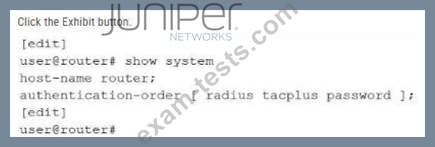
Exhibit: You have configured multiple authentication methods on your Junos device, including RADIUS, TACACS+, and local user accounts. A user attempts to log in, but the RADIUS server is unavailable. Referring to the exhibit, which statement is correct?
Correct Answer: D
In the Junos OS architecture, the authentication-order statement within the [edit system] hierarchy defines the sequence in which the device attempts to validate user credentials against external and internal databases. The order specified in the exhibit is [ radius tacplus password ] , meaning the device first queries the RADIUS server, followed by the TACACS+ server, and finally the local password database. A critical distinction in Junos authentication logic is the difference between a server being " unavailable " and a server " rejecting " a user. If an authentication server responds with an explicit access-reject (meaning it received the request but the credentials were invalid), the authentication process terminates immediately to maintain security integrity. However, if the server is unreachable or fails to respond within the configured timeout period (unavailable), the Junos Control Plane automatically falls back to the next method in the defined sequence. In this specific scenario, since the RADIUS server is unavailable, the device will proceed to attempt authentication using the TACACS+ server. If that were also unavailable, it would finally check the local password database. This fallback mechanism ensures that administrators can still access the device even during external server outages, provided they have a local account configured as the final method in the list. Reference: User Interfaces, System Authentication, Authentication Order and Fallback.
Question 60
Which statement is correct when multiple users are configuring a Junos device using the configure private command?
Correct Answer: C
When multiple users are configuring a Junos device using the "configure private" command, each user gets their own candidate configuration (C). This allows for isolated configuration sessions, where changes made by one user do not impact or interfere with the changes made by another user in their private session.