You are configuring a new router and want to ensure that you can recover from future misconfigurations. In this scenario, what should you do after completing the initial configuration?
Correct Answer: C
Creating a rescue configuration saves a known good configuration that can be quickly restored in case of future misconfigurations, providing a reliable recovery point.
Question 67
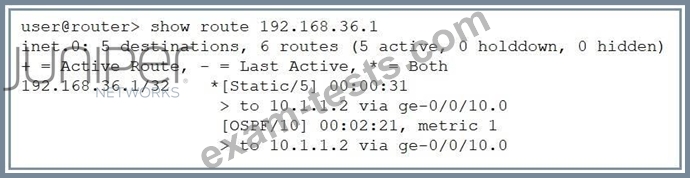
Referring to the exhibit, which route(s) will be selected by Junos for packet forwarding?
Correct Answer: B
Junos OS selects routes based on the route preference (also known as administrative distance). Static routes typically have a lower route preference than OSPF routes, meaning they are more preferred. Since the static route to 192.168.36.1/32 is shown with a preference of 5, it will be selected over the OSPF route for packet forwarding, assuming no other factors such as route filters or policies affect the routing decision.
Question 68
You power on a new MX Series router for the first time and connect to the console. You notice that no transit interfaces are passing traffic. In this scenario, which statement is correct?
Correct Answer: D
When you initially unbox and power on a Juniper MX Series router, it loads a factory-default configuration . Unlike some consumer-grade or lower-end enterprise switches that might have all ports active in a default VLAN, high-performance routers like the MX Series prioritize security and intentionality. In the factory- default state, the transit interfaces are not configured . While the physical hardware interfaces (such as ge-0/0/0 or xe-0/1/0) are detected by the Junos kernel, they lack any logical unit or protocol family definitions (like family inet or family inet6). Without a logical unit- even a simple unit 0-the Packet Forwarding Engine (PFE) will not accept or forward any traffic arriving on those ports. Furthermore, as discussed in previous questions, the device is essentially in a " locked " state; you cannot even commit new changes to enable these interfaces until you have defined a root-authentication password. This " blank slate " approach ensures that no traffic accidentally flows through a newly installed provider-edge device until an architect has explicitly defined the routing policies, firewall filters, and interface parameters required for the specific network environment. To begin passing traffic, you must manually define the logical units and assign the appropriate IP addresses or switching parameters to each interface. Reference: Configuration Basics, Initial Configuration, Factory Default Settings.
Question 69
You must view the forwarding table on your Junos device to troubleshoot a packet forwarding issue. In this scenario, which command would display the forwarding table?
Correct Answer: B
To effectively troubleshoot packet forwarding in a Junos environment, an architect must distinguish between the control plane ' s Routing Information Base (RIB) and the data plane ' s Forwarding Information Base (FIB). While the command show route displays the RIB (the master routing table maintained by the Routing Engine), it does not necessarily reflect the actual instructions being executed by the hardware. The definitive command for viewing the data plane ' s active path selection is show route forwarding-table. Executing this command reveals the contents of the FIB as it has been pushed from the Routing Engine to the Packet Forwarding Engine (PFE). The output provides critical diagnostic data, including the destination prefix, the specific next-hop IP address, the interface through which the packet will egress, and the type of route (such as unicast or broadcast). This is the " ground truth " for packet movement; if a route exists in the RIB but is missing from the forwarding table, it indicates a failure in the communication between the RE and PFE. Utilizing this command is the primary method for identifying black holes, incorrect next-hop resolution, or issues with hardware-level filter applications that might be impacting transit traffic flow at wire speed. Reference: Routing Fundamentals, Forwarding Information Base (FIB), Troubleshooting Forwarding.
Question 70
Which two statements are examples of exception traffic? (Choose two.)
Correct Answer: A,B
Exception traffic is handled by the Routing Engine instead of being forwarded by the Packet Forwarding Engine. Packets with the Router Alert option require special processing by the control plane, and SSH traffic directed to the device itself is also processed by the Routing Engine.