

Question 281
You have an Azure Active Directory (Azure AD) tenant named contoso.com that contains a user named User1.
User1 has the devices shown in the following table.

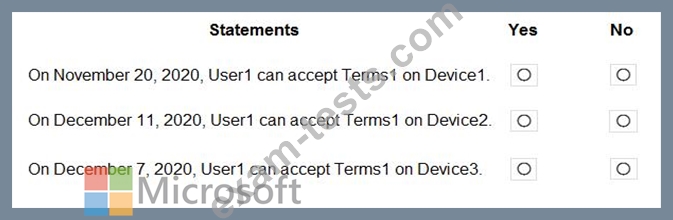
On November 5, 2020, you create and enforce terms of use in contoso.com that has the following settings:
Name: Terms1
Display name: Contoso terms of use
Require users to expand the terms of use: On
Require users to consent on every device: On
Expire consents: On
Expire starting on: December 10, 2020
Frequency: Monthly
On November 15, 2020, User1 accepts Terms1 on Device3.
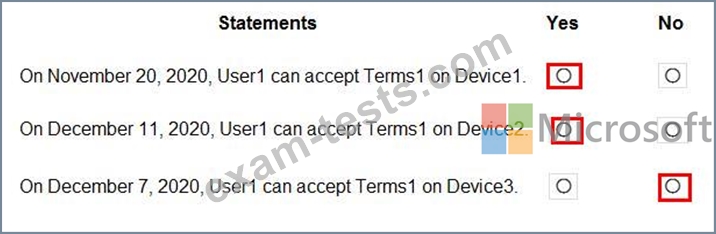
For each of the following statements, select Yes if the statement is true. Otherwise, select No.
NOTE: Each correct selection is worth one point.
User1 has the devices shown in the following table.
On November 5, 2020, you create and enforce terms of use in contoso.com that has the following settings:
Name: Terms1
Display name: Contoso terms of use
Require users to expand the terms of use: On
Require users to consent on every device: On
Expire consents: On
Expire starting on: December 10, 2020
Frequency: Monthly
On November 15, 2020, User1 accepts Terms1 on Device3.
For each of the following statements, select Yes if the statement is true. Otherwise, select No.
NOTE: Each correct selection is worth one point.
Question 282
You have an Azure Active Directory (Azure AD) tenant named contoso.com.
All users who run applications registered in Azure AD are subject to conditional access policies.
You need to prevent the users from using legacy authentication.
What should you include in the conditional access policies to filter out legacy authentication attempts?
All users who run applications registered in Azure AD are subject to conditional access policies.
You need to prevent the users from using legacy authentication.
What should you include in the conditional access policies to filter out legacy authentication attempts?
Question 283
You have an Azure Active Directory (Azure AD) tenant.
You need to review the Azure AD sign-in logs to investigate sign-ins that occurred in the past.
For how long does Azure AD store events in the sign-in logs?
You need to review the Azure AD sign-in logs to investigate sign-ins that occurred in the past.
For how long does Azure AD store events in the sign-in logs?
Question 284
You have a Microsoft 365 E5 subscription that contains the users shown in the following table.

The users are assigned the roles shown in the following table.

For which users can User1 and User4 reset passwords? To answer, select the appropriate options in the answer area.
NOTE: Each correct selection is worth one point.

The users are assigned the roles shown in the following table.
For which users can User1 and User4 reset passwords? To answer, select the appropriate options in the answer area.
NOTE: Each correct selection is worth one point.


Question 285
You have a Microsoft 365 E5 subscription.
You create an access review named Review1. Review1 requires that every six months, Microsoft
365 group owners review guest user access to their groups.
You need to ensure that if the group owners fail to review the membership of Review1, guest users are removed automatically.
Which settings should you configure for Review1?
You create an access review named Review1. Review1 requires that every six months, Microsoft
365 group owners review guest user access to their groups.
You need to ensure that if the group owners fail to review the membership of Review1, guest users are removed automatically.
Which settings should you configure for Review1?