
- Home
- ISC Certification
- SSCP Exam
- ISC.SSCP.v2022-08-26.q999 Practice Test

Question 51
Which of the following is most concerned with personnel security?
Correct Answer: B
Section: Security Operation Adimnistration
Explanation/Reference:
Many important issues in computer security involve human users, designers, implementers, and managers.
A broad range of security issues relates to how these individuals interact with computers and the access and authorities they need to do their jobs. Since operational controls address security methods focusing on mechanisms primarily implemented and executed by people (as opposed to systems), personnel security is considered a form of operational control.
Operational controls are put in place to improve security of a particular system (or group of systems). They often require specialized expertise and often rely upon management activities as well as technical controls.
Implementing dual control and making sure that you have more than one person that can perform a task would fall into this category as well.
Management controls focus on the management of the IT security system and the management of risk for a system. They are techniques and concerns that are normally addressed by management.
Technical controls focus on security controls that the computer system executes. The controls can provide automated protection for unauthorized access of misuse, facilitate detection of security violations, and support security requirements for applications and data.
Reference use for this question:
NIST SP 800-53 Revision 4 http://dx.doi.org/10.6028/NIST.SP.800-53r4
You can get it as a word document by clicking HERE
NIST SP 800-53 Revision 4 has superseded the document below:
SWANSON, Marianne, NIST Special Publication 800-26, Security Self-Assessment Guide for Information Technology Systems, November 2001 (Page A-18).
Explanation/Reference:
Many important issues in computer security involve human users, designers, implementers, and managers.
A broad range of security issues relates to how these individuals interact with computers and the access and authorities they need to do their jobs. Since operational controls address security methods focusing on mechanisms primarily implemented and executed by people (as opposed to systems), personnel security is considered a form of operational control.
Operational controls are put in place to improve security of a particular system (or group of systems). They often require specialized expertise and often rely upon management activities as well as technical controls.
Implementing dual control and making sure that you have more than one person that can perform a task would fall into this category as well.
Management controls focus on the management of the IT security system and the management of risk for a system. They are techniques and concerns that are normally addressed by management.
Technical controls focus on security controls that the computer system executes. The controls can provide automated protection for unauthorized access of misuse, facilitate detection of security violations, and support security requirements for applications and data.
Reference use for this question:
NIST SP 800-53 Revision 4 http://dx.doi.org/10.6028/NIST.SP.800-53r4
You can get it as a word document by clicking HERE
NIST SP 800-53 Revision 4 has superseded the document below:
SWANSON, Marianne, NIST Special Publication 800-26, Security Self-Assessment Guide for Information Technology Systems, November 2001 (Page A-18).
Question 52
Which of the following is the biggest concern with firewall security?
Correct Answer: B
Firewalls tend to give a false sense of security. They can be very hard to bypass but they need to be properly configured. The complexity of configuration rules can introduce a vulnerability when the person responsible for its configuration does not fully understand all possible options and switches. Denial of service attacks mainly concerns availability. Source: HARRIS, Shon, All-In-One CISSP Certification Exam Guide, McGraw-Hill/Osborne, 2002, Chapter 3: Telecommunications and Network Security (page 412).
Question 53
Which of the following would best describe certificate path validation?
Correct Answer: A
Explanation/Reference:
With the advent of public key cryptography (PKI), it is now possible to communicate securely with untrusted parties over the Internet without prior arrangement. One of the necessities arising from such communication is the ability to accurately verify someone's identity (i.e. whether the person you are communicating with is indeed the person who he/she claims to be). In order to be able to perform identity check for a given entity, there should be a fool-proof method of "binding" the entity's public key to its unique domain name (DN).
A X.509 digital certificate issued by a well known certificate authority (CA), like Verisign, Entrust, Thawte, etc., provides a way of positively identifying the entity by placing trust on the CA to have performed the necessary verifications. A X.509 certificate is a cryptographically sealed data object that contains the entity's unique DN, public key, serial number, validity period, and possibly other extensions.
The Windows Operating System offers a Certificate Viewer utility which allows you to double-click on any certificate and review its attributes in a human-readable format. For instance, the "General" tab in the Certificate Viewer Window (see below) shows who the certificate was issued to as well as the certificate's issuer, validation period and usage functions.
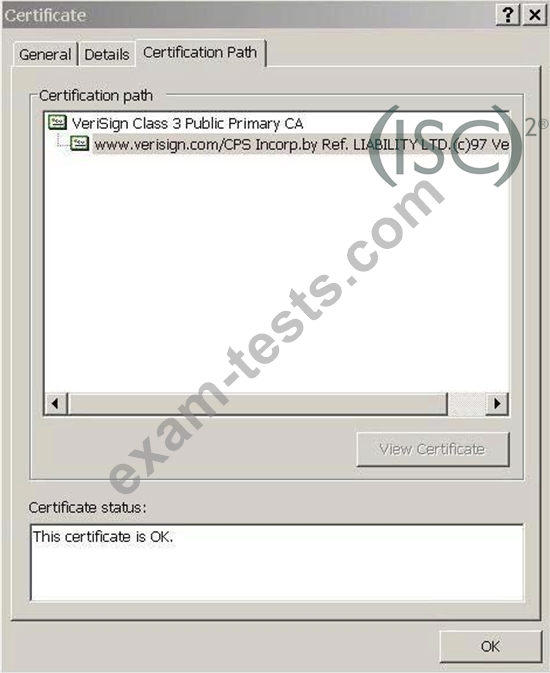
Certification Path graphic
The "Certification Path" tab contains the hierarchy for the chain of certificates. It allows you to select the certificate issuer or a subordinate certificate and then click on "View Certificate" to open the certificate in the Certificate Viewer.
Each end-user certificate is signed by its issuer, a trusted CA, by taking a hash value (MD5 or SHA-1) of ASN.1 DER (Distinguished Encoding Rule) encoded object and then encrypting the resulting hash with the issuer's private key (CA's Private Key) which is a digital signature. The encrypted data is stored in the
"signatureValue" attribute of the entity's (CA) public certificate.
Once the certificate is signed by the issuer, a party who wishes to communicate with this entity can then take the entity's public certificate and find out who the issuer of the certificate is. Once the issuer's of the certificate (CA) is identified, it would be possible to decrypt the value of the "signatureValue" attribute in the entity's certificate using the issuer's public key to retrieve the hash value. This hash value will be compared with the independently calculated hash on the entity's certificate. If the two hash values match, then the information contained within the certificate must not have been altered and, therefore, one must trust that the CA has done enough background check to ensure that all details in the entity's certificate are accurate.
The process of cryptographically checking the signatures of all certificates in the certificate chain is called
"key chaining". An additional check that is essential to key chaining is verifying that the value of the
"subjectKeyIdentifier" extension in one certificate matches the same in the subsequent certificate.
Similarly, the process of comparing the subject field of the issuer certificate to the issuer field of the subordinate certificate is called "name chaining". In this process, these values must match for each pair of adjacent certificates in the certification path in order to guarantee that the path represents unbroken chain of entities relating directly to one another and that it has no missing links.
The two steps above are the steps to validate the Certification Path by ensuring the validity of all certificates of the certificate chain to the root certificate as described in the two paragraphs above.
Reference(s) used for this question:
FORD, Warwick & BAUM, Michael S., Secure Electronic Commerce: Building the Infrastructure for Digital Signatures and Encryption (2nd Edition), 2000, Prentice Hall PTR, Page 262.
and
https://www.tibcommunity.com/docs/DOC-2197
With the advent of public key cryptography (PKI), it is now possible to communicate securely with untrusted parties over the Internet without prior arrangement. One of the necessities arising from such communication is the ability to accurately verify someone's identity (i.e. whether the person you are communicating with is indeed the person who he/she claims to be). In order to be able to perform identity check for a given entity, there should be a fool-proof method of "binding" the entity's public key to its unique domain name (DN).
A X.509 digital certificate issued by a well known certificate authority (CA), like Verisign, Entrust, Thawte, etc., provides a way of positively identifying the entity by placing trust on the CA to have performed the necessary verifications. A X.509 certificate is a cryptographically sealed data object that contains the entity's unique DN, public key, serial number, validity period, and possibly other extensions.
The Windows Operating System offers a Certificate Viewer utility which allows you to double-click on any certificate and review its attributes in a human-readable format. For instance, the "General" tab in the Certificate Viewer Window (see below) shows who the certificate was issued to as well as the certificate's issuer, validation period and usage functions.
Certification Path graphic
The "Certification Path" tab contains the hierarchy for the chain of certificates. It allows you to select the certificate issuer or a subordinate certificate and then click on "View Certificate" to open the certificate in the Certificate Viewer.
Each end-user certificate is signed by its issuer, a trusted CA, by taking a hash value (MD5 or SHA-1) of ASN.1 DER (Distinguished Encoding Rule) encoded object and then encrypting the resulting hash with the issuer's private key (CA's Private Key) which is a digital signature. The encrypted data is stored in the
"signatureValue" attribute of the entity's (CA) public certificate.
Once the certificate is signed by the issuer, a party who wishes to communicate with this entity can then take the entity's public certificate and find out who the issuer of the certificate is. Once the issuer's of the certificate (CA) is identified, it would be possible to decrypt the value of the "signatureValue" attribute in the entity's certificate using the issuer's public key to retrieve the hash value. This hash value will be compared with the independently calculated hash on the entity's certificate. If the two hash values match, then the information contained within the certificate must not have been altered and, therefore, one must trust that the CA has done enough background check to ensure that all details in the entity's certificate are accurate.
The process of cryptographically checking the signatures of all certificates in the certificate chain is called
"key chaining". An additional check that is essential to key chaining is verifying that the value of the
"subjectKeyIdentifier" extension in one certificate matches the same in the subsequent certificate.
Similarly, the process of comparing the subject field of the issuer certificate to the issuer field of the subordinate certificate is called "name chaining". In this process, these values must match for each pair of adjacent certificates in the certification path in order to guarantee that the path represents unbroken chain of entities relating directly to one another and that it has no missing links.
The two steps above are the steps to validate the Certification Path by ensuring the validity of all certificates of the certificate chain to the root certificate as described in the two paragraphs above.
Reference(s) used for this question:
FORD, Warwick & BAUM, Michael S., Secure Electronic Commerce: Building the Infrastructure for Digital Signatures and Encryption (2nd Edition), 2000, Prentice Hall PTR, Page 262.
and
https://www.tibcommunity.com/docs/DOC-2197
Question 54
The primary purpose for using one-way hashing of user passwords within a password file is which of the following?
Correct Answer: B
Explanation/Reference:
The whole idea behind a one-way hash is that it should be just that - one-way. In other words, an attacker should not be able to figure out your password from the hashed version of that password in any mathematically feasible way (or within any reasonable length of time).
Password Hashing and Encryption
In most situations , if an attacker sniffs your password from the network wire, she still has some work to do before she actually knows your password value because most systems hash the password with a hashing algorithm, commonly MD4 or MD5, to ensure passwords are not sent in cleartext.
Although some people think the world is run by Microsoft, other types of operating systems are out there, such as Unix and Linux. These systems do not use registries and SAM databases, but contain their user passwords in a file cleverly called "shadow." Now, this shadow file does not contain passwords in cleartext; instead, your password is run through a hashing algorithm, and the resulting value is stored in this file.
Unixtype systems zest things up by using salts in this process. Salts are random values added to the encryption process to add more complexity and randomness. The more randomness entered into the encryption process, the harder it is for the bad guy to decrypt and uncover your password. The use of a salt means that the same password can be encrypted into several thousand different formats. This makes it much more difficult for an attacker to uncover the right format for your system.
Password Cracking tools
Note that the use of one-way hashes for passwords does not prevent password crackers from guessing passwords. A password cracker runs a plain-text string through the same one-way hash algorithm used by the system to generate a hash, then compares that generated has with the one stored on the system. If they match, the password cracker has guessed your password.
This is very much the same process used to authenticate you to a system via a password. When you type your username and password, the system hashes the password you typed and compares that generated hash against the one stored on the system - if they match, you are authenticated.
Pre-Computed password tables exists today and they allow you to crack passwords on Lan Manager (LM) within a VERY short period of time through the use of Rainbow Tables. A Rainbow Table is a precomputed table for reversing cryptographic hash functions, usually for cracking password hashes.
Tables are usually used in recovering a plaintext password up to a certain length consisting of a limited set of characters. It is a practical example of a space/time trade-off also called a Time-Memory trade off, using more computer processing time at the cost of less storage when calculating a hash on every attempt, or less processing time and more storage when compared to a simple lookup table with one entry per hash.
Use of a key derivation function that employs a salt makes this attack unfeasible.
You may want to review "Rainbow Tables" at the links:
http://en.wikipedia.org/wiki/Rainbow_table
http://www.antsight.com/zsl/rainbowcrack/
Today's password crackers:
Meet oclHashcat. They are GPGPU-based multi-hash cracker using a brute-force attack (implemented as mask attack), combinator attack, dictionary attack, hybrid attack, mask attack, and rule-based attack.
This GPU cracker is a fusioned version of oclHashcat-plus and oclHashcat-lite, both very well-known suites at that time, but now deprecated. There also existed a now very old oclHashcat GPU cracker that was replaced w/ plus and lite, which - as said - were then merged into oclHashcat 1.00 again.
This cracker can crack Hashes of NTLM Version 2 up to 8 characters in less than a few hours. It is definitively a game changer. It can try hundreds of billions of tries per seconds on a very large cluster of GPU's. It supports up to 128 Video Cards at once.
I am stuck using Password what can I do to better protect myself?
You could look at safer alternative such as Bcrypt, PBKDF2, and Scrypt.
bcrypt is a key derivation function for passwords designed by Niels Provos and David Mazières, based on the Blowfish cipher, and presented at USENIX in 1999. Besides incorporating a salt to protect against rainbow table attacks, bcrypt is an adaptive function: over time, the iteration count can be increased to make it slower, so it remains resistant to brute-force search attacks even with increasing computation power.
In cryptography, scrypt is a password-based key derivation function created by Colin Percival, originally for the Tarsnap online backup service. The algorithm was specifically designed to make it costly to perform large-scale custom hardware attacks by requiring large amounts of memory. In 2012, the scrypt algorithm was published by the IETF as an Internet Draft, intended to become an informational RFC, which has since expired. A simplified version of scrypt is used as a proof-of-work scheme by a number of cryptocurrencies, such as Litecoin and Dogecoin.
PBKDF2 (Password-Based Key Derivation Function 2) is a key derivation function that is part of RSA Laboratories' Public-Key Cryptography Standards (PKCS) series, specifically PKCS #5 v2.0, also published as Internet Engineering Task Force's RFC 2898. It replaces an earlier standard, PBKDF1, which could only produce derived keys up to 160 bits long.
PBKDF2 applies a pseudorandom function, such as a cryptographic hash, cipher, or HMAC to the input password or passphrase along with a salt value and repeats the process many times to produce a derived key, which can then be used as a cryptographic key in subsequent operations. The added computational work makes password cracking much more difficult, and is known as key stretching. When the standard was written in 2000, the recommended minimum number of iterations was 1000, but the parameter is intended to be increased over time as CPU speeds increase. Having a salt added to the password reduces the ability to use precomputed hashes (rainbow tables) for attacks, and means that multiple passwords have to be tested individually, not all at once. The standard recommends a salt length of at least 64 bits.
The other answers are incorrect:
"It prevents an unauthorized person from trying multiple passwords in one logon attempt." is incorrect because the fact that a password has been hashed does not prevent this type of brute force password guessing attempt.
"It minimizes the amount of storage required for user passwords" is incorrect because hash algorithms always generate the same number of bits, regardless of the length of the input. Therefore, even short passwords will still result in a longer hash and not minimize storage requirements.
"It minimizes the amount of processing time used for encrypting passwords" is incorrect because the processing time to encrypt a password would be basically the same required to produce a one-way has of the same password.
Reference(s) used for this question:
http://en.wikipedia.org/wiki/PBKDF2
http://en.wikipedia.org/wiki/Scrypt
http://en.wikipedia.org/wiki/Bcrypt
Harris, Shon (2012-10-18). CISSP All-in-One Exam Guide, 6th Edition (p. 195) . McGraw-Hill. Kindle Edition.
The whole idea behind a one-way hash is that it should be just that - one-way. In other words, an attacker should not be able to figure out your password from the hashed version of that password in any mathematically feasible way (or within any reasonable length of time).
Password Hashing and Encryption
In most situations , if an attacker sniffs your password from the network wire, she still has some work to do before she actually knows your password value because most systems hash the password with a hashing algorithm, commonly MD4 or MD5, to ensure passwords are not sent in cleartext.
Although some people think the world is run by Microsoft, other types of operating systems are out there, such as Unix and Linux. These systems do not use registries and SAM databases, but contain their user passwords in a file cleverly called "shadow." Now, this shadow file does not contain passwords in cleartext; instead, your password is run through a hashing algorithm, and the resulting value is stored in this file.
Unixtype systems zest things up by using salts in this process. Salts are random values added to the encryption process to add more complexity and randomness. The more randomness entered into the encryption process, the harder it is for the bad guy to decrypt and uncover your password. The use of a salt means that the same password can be encrypted into several thousand different formats. This makes it much more difficult for an attacker to uncover the right format for your system.
Password Cracking tools
Note that the use of one-way hashes for passwords does not prevent password crackers from guessing passwords. A password cracker runs a plain-text string through the same one-way hash algorithm used by the system to generate a hash, then compares that generated has with the one stored on the system. If they match, the password cracker has guessed your password.
This is very much the same process used to authenticate you to a system via a password. When you type your username and password, the system hashes the password you typed and compares that generated hash against the one stored on the system - if they match, you are authenticated.
Pre-Computed password tables exists today and they allow you to crack passwords on Lan Manager (LM) within a VERY short period of time through the use of Rainbow Tables. A Rainbow Table is a precomputed table for reversing cryptographic hash functions, usually for cracking password hashes.
Tables are usually used in recovering a plaintext password up to a certain length consisting of a limited set of characters. It is a practical example of a space/time trade-off also called a Time-Memory trade off, using more computer processing time at the cost of less storage when calculating a hash on every attempt, or less processing time and more storage when compared to a simple lookup table with one entry per hash.
Use of a key derivation function that employs a salt makes this attack unfeasible.
You may want to review "Rainbow Tables" at the links:
http://en.wikipedia.org/wiki/Rainbow_table
http://www.antsight.com/zsl/rainbowcrack/
Today's password crackers:
Meet oclHashcat. They are GPGPU-based multi-hash cracker using a brute-force attack (implemented as mask attack), combinator attack, dictionary attack, hybrid attack, mask attack, and rule-based attack.
This GPU cracker is a fusioned version of oclHashcat-plus and oclHashcat-lite, both very well-known suites at that time, but now deprecated. There also existed a now very old oclHashcat GPU cracker that was replaced w/ plus and lite, which - as said - were then merged into oclHashcat 1.00 again.
This cracker can crack Hashes of NTLM Version 2 up to 8 characters in less than a few hours. It is definitively a game changer. It can try hundreds of billions of tries per seconds on a very large cluster of GPU's. It supports up to 128 Video Cards at once.
I am stuck using Password what can I do to better protect myself?
You could look at safer alternative such as Bcrypt, PBKDF2, and Scrypt.
bcrypt is a key derivation function for passwords designed by Niels Provos and David Mazières, based on the Blowfish cipher, and presented at USENIX in 1999. Besides incorporating a salt to protect against rainbow table attacks, bcrypt is an adaptive function: over time, the iteration count can be increased to make it slower, so it remains resistant to brute-force search attacks even with increasing computation power.
In cryptography, scrypt is a password-based key derivation function created by Colin Percival, originally for the Tarsnap online backup service. The algorithm was specifically designed to make it costly to perform large-scale custom hardware attacks by requiring large amounts of memory. In 2012, the scrypt algorithm was published by the IETF as an Internet Draft, intended to become an informational RFC, which has since expired. A simplified version of scrypt is used as a proof-of-work scheme by a number of cryptocurrencies, such as Litecoin and Dogecoin.
PBKDF2 (Password-Based Key Derivation Function 2) is a key derivation function that is part of RSA Laboratories' Public-Key Cryptography Standards (PKCS) series, specifically PKCS #5 v2.0, also published as Internet Engineering Task Force's RFC 2898. It replaces an earlier standard, PBKDF1, which could only produce derived keys up to 160 bits long.
PBKDF2 applies a pseudorandom function, such as a cryptographic hash, cipher, or HMAC to the input password or passphrase along with a salt value and repeats the process many times to produce a derived key, which can then be used as a cryptographic key in subsequent operations. The added computational work makes password cracking much more difficult, and is known as key stretching. When the standard was written in 2000, the recommended minimum number of iterations was 1000, but the parameter is intended to be increased over time as CPU speeds increase. Having a salt added to the password reduces the ability to use precomputed hashes (rainbow tables) for attacks, and means that multiple passwords have to be tested individually, not all at once. The standard recommends a salt length of at least 64 bits.
The other answers are incorrect:
"It prevents an unauthorized person from trying multiple passwords in one logon attempt." is incorrect because the fact that a password has been hashed does not prevent this type of brute force password guessing attempt.
"It minimizes the amount of storage required for user passwords" is incorrect because hash algorithms always generate the same number of bits, regardless of the length of the input. Therefore, even short passwords will still result in a longer hash and not minimize storage requirements.
"It minimizes the amount of processing time used for encrypting passwords" is incorrect because the processing time to encrypt a password would be basically the same required to produce a one-way has of the same password.
Reference(s) used for this question:
http://en.wikipedia.org/wiki/PBKDF2
http://en.wikipedia.org/wiki/Scrypt
http://en.wikipedia.org/wiki/Bcrypt
Harris, Shon (2012-10-18). CISSP All-in-One Exam Guide, 6th Edition (p. 195) . McGraw-Hill. Kindle Edition.
Question 55
The Data Encryption Standard (DES) encryption algorithm has which of the following characteristics?
Correct Answer: C
Explanation/Reference:
DES works with 64 bit blocks of text using a 64 bit key (with 8 bits used for parity, so the effective key length is 56 bits).
Some people are getting the Key Size and the Block Size mixed up. The block size is usually a specific length. For example DES uses block size of 64 bits which results in 64 bits of encrypted data for each block. AES uses a block size of 128 bits, the block size on AES can only be 128 as per the published standard FIPS-197.
A DES key consists of 64 binary digits ("0"s or "1"s) of which 56 bits are randomly generated and used directly by the algorithm. The other 8 bits, which are not used by the algorithm, may be used for error detection. The 8 error detecting bits are set to make the parity of each 8-bit byte of the key odd, i.e., there is an odd number of "1"s in each 8-bit byte1. Authorized users of encrypted computer data must have the key that was used to encipher the data in order to decrypt it.
IN CONTRAST WITH AES
The input and output for the AES algorithm each consist of sequences of 128 bits (digits with values of 0 or
1). These sequences will sometimes be referred to as blocks and the number of bits they contain will be referred to as their length. The Cipher Key for the AES algorithm is a sequence of 128, 192 or 256 bits.
Other input, output and Cipher Key lengths are not permitted by this standard.
The Advanced Encryption Standard (AES) specifies the Rijndael algorithm, a symmetric block cipher that can process data blocks of 128 bits, using cipher keys with lengths of 128, 192, and 256 bits. Rijndael was designed to handle additional block sizes and key lengths, however they are not adopted in the AES standard.
The AES algorithm may be used with the three different key lengths indicated above, and therefore these different "flavors" may be referred to as "AES-128", "AES-192", and "AES-256".
The other answers are not correct because:
"64 bits of data input results in 56 bits of encrypted output" is incorrect because while DES does work with
64 bit block input, it results in 64 bit blocks of encrypted output.
"128 bit key with 8 bits used for parity" is incorrect because DES does not ever use a 128 bit key.
"56 bits of data input results in 56 bits of encrypted output" is incorrect because DES always works with 64 bit blocks of input/output, not 56 bits.
Reference(s) used for this question:
Official ISC2 Guide to the CISSP CBK, Second Edition, page: 336-343
http://csrc.nist.gov/publications/fips/fips197/fips-197.pdf
http://csrc.nist.gov/publications/fips/fips46-3/fips46-3.pdf
DES works with 64 bit blocks of text using a 64 bit key (with 8 bits used for parity, so the effective key length is 56 bits).
Some people are getting the Key Size and the Block Size mixed up. The block size is usually a specific length. For example DES uses block size of 64 bits which results in 64 bits of encrypted data for each block. AES uses a block size of 128 bits, the block size on AES can only be 128 as per the published standard FIPS-197.
A DES key consists of 64 binary digits ("0"s or "1"s) of which 56 bits are randomly generated and used directly by the algorithm. The other 8 bits, which are not used by the algorithm, may be used for error detection. The 8 error detecting bits are set to make the parity of each 8-bit byte of the key odd, i.e., there is an odd number of "1"s in each 8-bit byte1. Authorized users of encrypted computer data must have the key that was used to encipher the data in order to decrypt it.
IN CONTRAST WITH AES
The input and output for the AES algorithm each consist of sequences of 128 bits (digits with values of 0 or
1). These sequences will sometimes be referred to as blocks and the number of bits they contain will be referred to as their length. The Cipher Key for the AES algorithm is a sequence of 128, 192 or 256 bits.
Other input, output and Cipher Key lengths are not permitted by this standard.
The Advanced Encryption Standard (AES) specifies the Rijndael algorithm, a symmetric block cipher that can process data blocks of 128 bits, using cipher keys with lengths of 128, 192, and 256 bits. Rijndael was designed to handle additional block sizes and key lengths, however they are not adopted in the AES standard.
The AES algorithm may be used with the three different key lengths indicated above, and therefore these different "flavors" may be referred to as "AES-128", "AES-192", and "AES-256".
The other answers are not correct because:
"64 bits of data input results in 56 bits of encrypted output" is incorrect because while DES does work with
64 bit block input, it results in 64 bit blocks of encrypted output.
"128 bit key with 8 bits used for parity" is incorrect because DES does not ever use a 128 bit key.
"56 bits of data input results in 56 bits of encrypted output" is incorrect because DES always works with 64 bit blocks of input/output, not 56 bits.
Reference(s) used for this question:
Official ISC2 Guide to the CISSP CBK, Second Edition, page: 336-343
http://csrc.nist.gov/publications/fips/fips197/fips-197.pdf
http://csrc.nist.gov/publications/fips/fips46-3/fips46-3.pdf
Premium Bundle
Newest SSCP Exam PDF Dumps shared by BraindumpsPass.com for Helping Passing SSCP Exam! BraindumpsPass.com now offer the updated SSCP exam dumps, the BraindumpsPass.com SSCP exam questions have been updated and answers have been corrected get the latest BraindumpsPass.com SSCP pdf dumps with Exam Engine here:
- Other Version
- 11729ISC.SSCP.v2024-11-11.q999
- 15415ISC.SSCP.v2024-05-23.q965
- 22618ISC.SSCP.v2022-01-29.q657
- 36ISC.Prepawaypdf.SSCP.v2021-11-05.by.harvey.888q.pdf
- Latest Upload
- 203Snowflake.DEA-C01.v2026-09-04.q215
- 160HP.HPE0-V27.v2026-09-04.q127
- 182NAHQ.CPHQ.v2026-09-03.q481
- 118SAP.C-S4CPB-2602.v2026-09-02.q7
- 114Cisco.700-805.v2026-09-02.q86
- 163MSSC.CLT-4.0.v2026-09-02.q43
- 131Fitness.NCSF-CPT.v2026-09-02.q18
- 194Google.Generative-AI-Leader.v2026-09-02.q77
- 140PECB.ISO-14001-Lead-Auditor.v2026-09-01.q39
- 129Google.GCP-DE.v2026-09-01.q27