How low does rule-based detection differ from behavioral detection?
Correct Answer: D
Rule-based detection systems operate using predefined patterns and signatures to identify known threats. These patterns are based on prior knowledge of attack methods and vulnerabilities. Behavioral detection systems, on the other hand, analyze the normal behavior of a network or system to establish a baseline. They then monitor for deviations from this baseline, which may indicate potential threats. Rule-based systems are effective at detecting known threats but may struggle with novel or zero-day attacks that do not match existing signatures. Behavioral systems can detect unknown threats by recognizing abnormal activities, making them useful in identifying zero-day exploits and other sophisticated attacks. Reference: Comparison of Rule-based and Behavioral Detection Methods in IDS Advantages of Behavioral Analysis in Network Security Cybersecurity Detection Techniques
Question 292
An employee reports that someone has logged into their system and made unapproved changes, files are out of order, and several documents have been placed in the recycle bin. The security specialist reviewed the system logs, found nothing suspicious, and was not able to determine what occurred. The software is up to date; there are no alerts from antivirus and no failed login attempts. What is causing the lack of data visibility needed to detect the attack?
Correct Answer: B
The lack of data visibility needed to detect the attack is caused by the threat actor gaining access to the system by known credentials. This means that the threat actor either obtained the employee's username and password through phishing, social engineering, or other means, or used a compromised account that had legitimate access to the system. This would explain why there were no suspicious logs, alerts, or failed login attempts, as the threat actor appeared to be a normal user. References: https://learningnetworkstore.cisco.com/on-demand- e-learning/understanding-cisco-cybersecurity-operations-fundamentals-cbrops-v1-0/CSCU-LP-CBROPS-V1- 028093.html (Module 2, Lesson 2.1.2)
Question 293
A security incident occurred with the potential of impacting business services. Who performs the attack?
Correct Answer: D
Question 294
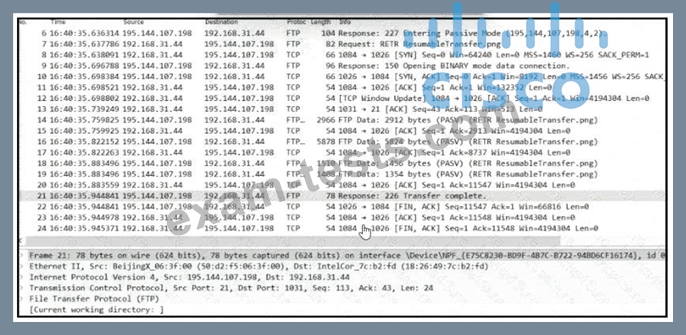
Refer to the exhibit. Which frame numbers contain a file that is extractable via TCP stream within Wireshark?
Correct Answer: A
The file that is extractable via TCP stream within Wireshark is the one that has the Content-Type header set to application/octet-stream, which indicates binary data. Thisheader is present in frames 7, 14, and 21, which are part of the same TCP stream. The other frames have different Content-Type headers, such as text/html or image/jpeg, which are not extractable as binary files. References := Understanding Cisco Cybersecurity Operations Fundamentals (CBROPS) v1.0, Module 3: Network Intrusion Analysis, Lesson 3.2: Analyze Data from Common TCP/IP Protocols, Topic 3.2.3: HTTP
Question 295
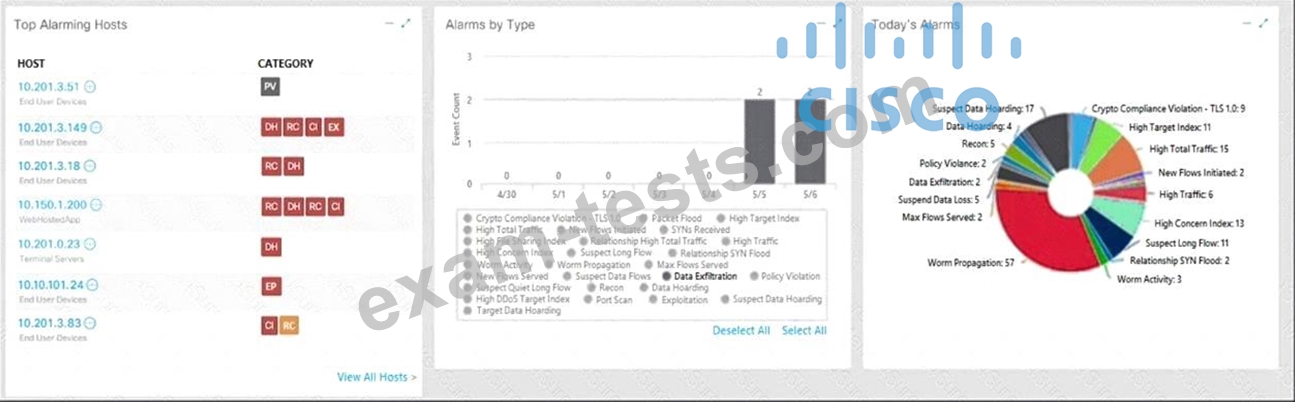
Refer to the exhibit. What is the potential threat identified in this Stealthwatch dashboard?
Correct Answer: C
The exhibit shows a Stealthwatch dashboard displaying information on alarming hosts, alarms by type, and today's alarms. On the left side under "Top Alarming Hosts," there are five host IP addresses listed with their respective categories indicating different types of alerts including 'Data Hoarding' and 'Exfiltration.' In "Alarms by Type" section at center top part of image shows bar graphs representing various alarm types including 'Crypto Violation' with their respective counts. On right side under "Today's Alarms," there's a table showing the details of each alarm such as the host IP, the alarm type, the severity, and the time. The potential threat identified in this dashboard is that there are two active data exfiltration alerts, one for host 10.201.3.149 and another for host 10.10.101.24. Data exfiltration is the unauthorized transfer of data from a compromised system to an external destination, such as a command and control server or a malicious actor. This can result in data loss, breach of confidentiality, and damage to the organization's reputation and assets. References := Cisco Cybersecurity Operations Fundamentals - Module 7: Network and Host Forensics