

Question 41
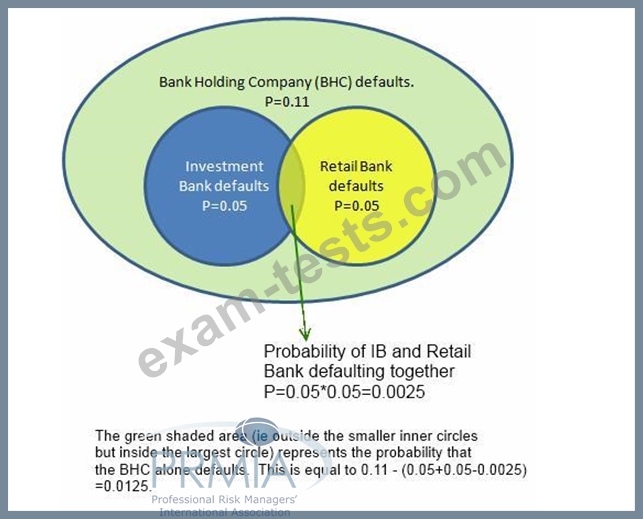
A Bank Holding Company (BHC) is invested in an investment bank and a retail bank. The BHC defaults for certain if either the investment bank or the retail bank defaults. However, the BHC can also default on its own without either the investment bank or the retail bank defaulting. The investment bank and the retail bank's defaults are independent of each other, with a probability of default of 0.05 each. The BHC's probability of default is 0.11.
What is the probabilityof default of both the BHC and the investment bank? What is the probability of the BHC's default provided both the investment bank and the retail bank survive?
What is the probabilityof default of both the BHC and the investment bank? What is the probability of the BHC's default provided both the investment bank and the retail bank survive?
Question 42
Which of the following statements are true:
I. A transition matrix is the probability of a security migrating from one rating class to another during its lifetime.
II. Marginal default probabilities refer to probabilities of default in a particular period, given survival atthe beginning of that period.
III. Marginal default probabilities will always be greater than the corresponding cumulative default probability.
IV. Loss given default is generally greater when recovery rates are low.
Question 43
Which of the following statements are correct?
I. A reliance upon conditional probabilities and a-priori views of probabilities is called the 'frequentist' view II. Knightian uncertainty refers to thingsthat might happen but for which probabilities cannot be evaluated III. Risk mitigation and risk elimination are approaches to reacting to identified risks IV. Confidence accounting is a reference to the accounting frauds that were seen in the past decadeas a reflection of failed governance processes
I. A reliance upon conditional probabilities and a-priori views of probabilities is called the 'frequentist' view II. Knightian uncertainty refers to thingsthat might happen but for which probabilities cannot be evaluated III. Risk mitigation and risk elimination are approaches to reacting to identified risks IV. Confidence accounting is a reference to the accounting frauds that were seen in the past decadeas a reflection of failed governance processes
Question 44
The Altman credit risk score considers:
Question 45
The Basel framework does not permit which of the following Units of Measure (UoM) for operational risk modeling:
I. UoM based on legal entity
II. UoM based on event type
III. UoM based on geography
IV. UoM based on line of business
I. UoM based on legal entity
II. UoM based on event type
III. UoM based on geography
IV. UoM based on line of business