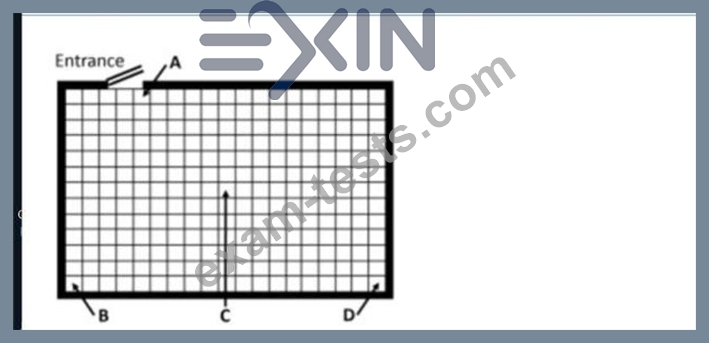
From the options indicated, what is the correct starting point for the raised floor installation?
Correct Answer: B
When installing a raised floor, the best starting point is typically from the farthest corner away from the entrance, in this case, Point B. This method allows for the floor installation to progress towards the entrance, ensuring that workers can avoid walking over the newly installed tiles, thus minimizing the risk of damage and maintaining cleanliness during installation. Detailed Explanation: Starting at the farthest corner (Point B) and working towards the entrance (Point A) is a standard practice in raised floor installation. This approach ensures that installers do not walk over freshly laid tiles, which could lead to shifting or misalignment. Additionally, it allows for more controlled placement and alignment, as well as convenient egress when installation is complete. EPI Data Center Specialist References: EPI guidelines for raised floor installation emphasize beginning at the farthest point from the entrance and working back towards it, which aligns with industry best practices for efficiency and quality assurance. This method reduces potential damage and supports precise alignment across the floor area.
Question 2
What is a potential disadvantage of using water mist as a fire extinguishing system?
Correct Answer: B
A potential disadvantage of using a water mist fire suppression system is that it can rapidly increase the humidity within the data center, which may pose risks to sensitive electronic equipment. Excessive humidity can lead to condensation, which could damage electronics and lead to short circuits or corrosion over time. Detailed Explanation: Water mist systems use fine droplets to suppress fires by cooling and displacing heat. However, the moisture generated may raise the humidity level to the point where it exceeds safe operational limits for IT equipment. Therefore, while water mist systems are effective in fire suppression, they may not be ideal in environments where high humidity could damage sensitive equipment. EPI Data Center Specialist References: EPI guidelines advise considering the impact of humidity from fire suppression systems, particularly in environments housing electronic equipment. It's essential to weigh the benefits of fire suppression against potential risks to operational equipment when choosing suppression methods.
Question 3
A data center has its own power supply from the public utility and receives chilled water supply from the building owner. What needs to be taken into consideration when calculating the PUE?
Correct Answer: C
When calculating Power Usage Effectiveness (PUE) in a data center that uses chilled water from an external source, like from a building owner, a weight factor for district chilled water must be applied. This is because PUE calculations aim to measure the energy efficiency of the data center's own operations, and external utilities like district chilled water aren't directly powered by the data center. A weight factor of 0.4 is typically used to account for the energy consumed to produce and deliver the chilled water, reflecting the indirect impact on the data center's total energy consumption. Detailed Explanation: PUE is calculated as the ratio of the total facility energy to the IT equipment energy. If the cooling is provided by an external chilled water source, it's necessary to adjust the calculations to accurately reflect the energy impact. By incorporating the 0.4 weight factor, data centers can calculate a more accurate PUE, aligning with standard methods and industry best practices. EPI Data Center Specialist References: EPI training on PUE highlights the importance of adjusting for external energy sources, such as district cooling, in the calculations. This ensures that PUE values remain accurate and comparable across different data centers, even when external utilities are used.
Question 4
You are changing the design of the fire suppression system for your computer room from a halocarbon fire suppression system into an inert-based fire suppression system. Could you use the same formula to calculate the gas content for the gas?
Correct Answer: A
The formula used to calculate the gas content differs significantly between halocarbon and inert-based fire suppression systems. Halocarbon systems function by absorbing heat, while inert systems work by reducing oxygen levels. Due to these differences in fire suppression mechanisms, distinct formulas are applied, factoring in the specific properties of each gas type and the required concentration levels. Detailed Explanation: Halocarbon systems like FM200 require a formula that accounts for the concentration needed for cooling, while inert gases like nitrogen or argon need a formula that calculates the volume based on oxygen displacement. As the design concentration and characteristics of these gases differ, it's essential to use the correct formula specific to the gas type. EPI Data Center Specialist References: EPI recommends consulting the specific design requirements and formulas provided by each gas manufacturer when switching fire suppression systems to ensure the correct amount of gas is deployed for effective fire suppression.
Question 5
The 'maximum exposed area' of the fire-rated glass is defined by the supplier as 3 sqm/32 sqft. The window area is 4 sqm/43 sqft. What would be the best option?
Correct Answer: C
When the window area exceeds the maximum exposed area specified for fire-rated glass, it is necessary to split the window into sections that comply with the fire rating requirements. This means creating smaller sections that are each within the 3 sqm/32 sqft limit and using fire-rated frames to ensure that the entire assembly meets fire safety standards. This approach maintains the fire-rated integrity of the glass, while allowing for larger window areas. Detailed Explanation: Fire-rated glass is designed to contain fire and prevent it from spreading. If the window exceeds the maximum exposed area defined by the supplier, the integrity of the fire-rated glass could be compromised. By dividing the window into compliant sections with fire-rated frames, you ensure that each pane performs as intended in the event of a fire. Fire-rated frames help maintain the fire resistance across the entire assembly, making this option the best for safety and compliance. EPI Data Center Specialist References: EPI recommends adhering strictly to fire safety standards, especially when using materials like fire-rated glass. The guidelines emphasize that modifications should always respect the manufacturer's specifications to ensure the system remains effective in containing and preventing the spread of fire.