When are the wet bulb and dry bulb temperatures identical?
Correct Answer: D
The wet bulb and dry bulb temperatures become identical when the relative humidity reaches 100%. At this point, the air is fully saturated with moisture, meaning it can no longer absorb additional water vapor. As a result, the rate of evaporation decreases, and there is no difference between the dry bulb and wet bulb temperatures. Detailed Explanation: The dry bulb temperature measures the air temperature, while the wet bulb temperature takes into account the cooling effect of evaporation. When relative humidity is at 100%, the air has reached its saturation point, and no further evaporation occurs. This causes both the wet bulb and dry bulb thermometers to display the same temperature reading. This condition is critical in understanding environmental conditions, particularly in HVAC and data center environments, where humidity control is essential to avoid equipment overheating or corrosion. EPI Data Center Specialist References: The EPI Data Center Specialist training includes understanding humidity levels and their impact on data center environments. Knowing when wet bulb and dry bulb temperatures align helps data center operators manage moisture levels effectively, which is essential for preventing issues related to high humidity, such as condensation on IT equipment.
Question 17
Three data centers are benchmarked on facilities energy efficiency. Data center A has achieved a PUE of 2.45. Data center B has achieved a PUE of 1.20. Data center C has achieved a PUE of 1.90. Which of the data centers is operating at the highest facility efficiency?
Correct Answer: B
A Power Usage Effectiveness (PUE) of 1.20 (achieved by Data Center B) indicates the highest facility efficiency among the three data centers. A lower PUE value signifies better energy efficiency, as it means that a greater proportion of the total energy consumed is used directly for IT equipment rather than for cooling, lighting, or other facility needs. Detailed Explanation: PUE is calculated as the ratio of total facility energy to IT equipment energy. A PUE close to 1.0 suggests that almost all the energy is dedicated to computing processes, with minimal overhead. With PUE values of 2.45, 1.20, and 1.90, Data Center B (1.20) operates most efficiently by devoting a higher percentage of its total energy to IT equipment. EPI Data Center Specialist References: The EPI curriculum emphasizes PUE as a key metric for data center efficiency, with lower values representing better performance. Achieving a PUE near 1.0 aligns with industry best practices for energy-efficient data center design and operation.
Question 18
What is a significant difference between a halocarbon gas-based fire suppression system and an inert gas-based fire suppression system?
Correct Answer: C
A halocarbon gas-based fire suppression system primarily extinguishes fires through heat absorption. In contrast, an inert gas-based system works by reducing oxygen levels to a point where combustion cannot be sustained. Halocarbon agents, like FM-200, absorb heat from the fire, cooling it down, whereas inert gases, like nitrogen or argon, lower oxygen concentration. Detailed Explanation: Halocarbons are effective in quickly cooling flames and are suitable for electronic environments due to their fast action. Inert gases displace oxygen to suppress fires, making them ideal in occupied spaces where human safety can be managed during a fire event due to slower discharge times. EPI Data Center Specialist References: EPI training distinguishes between these suppression mechanisms, noting the importance of selecting the correct system based on specific needs like quick response versus oxygen displacement for environments with sensitive equipment.
Question 19
A data center scores Rated-3 in mechanical, Rated-4 in electrical, and Rated-2 in architectural. What is the overall Rating of this data center when the Rating is based on the ANSI/TIA-942?
Correct Answer: A
According to ANSI/TIA-942 standards, the overall data center rating is determined by the lowest rating among all evaluated categories. Therefore, if a data center is rated 2 in architectural, despite being rated higher in mechanical and electrical, the overall rating is Rated-2. This approach ensures that all aspects meet a minimum standard and prevents a higher rating if any critical area does not comply. Detailed Explanation: ANSI/TIA-942 evaluates data centers across several areas, including mechanical, electrical, architectural, and telecommunications. The overall rating reflects the lowest rated category, ensuring that no aspect of the data center's design or operation falls below the specified level. Thus, in this case, the architectural rating of 2 dictates the final rating, ensuring a comprehensive and balanced assessment of reliability and resilience across all aspects. EPI Data Center Specialist References: EPI Data Center Specialist training aligns with ANSI/TIA-942, stating that the final rating must reflect the lowest score to ensure comprehensive reliability across all critical infrastructure categories. This avoids overstating the data center's resilience and ensures uniform standards across areas.
Question 20
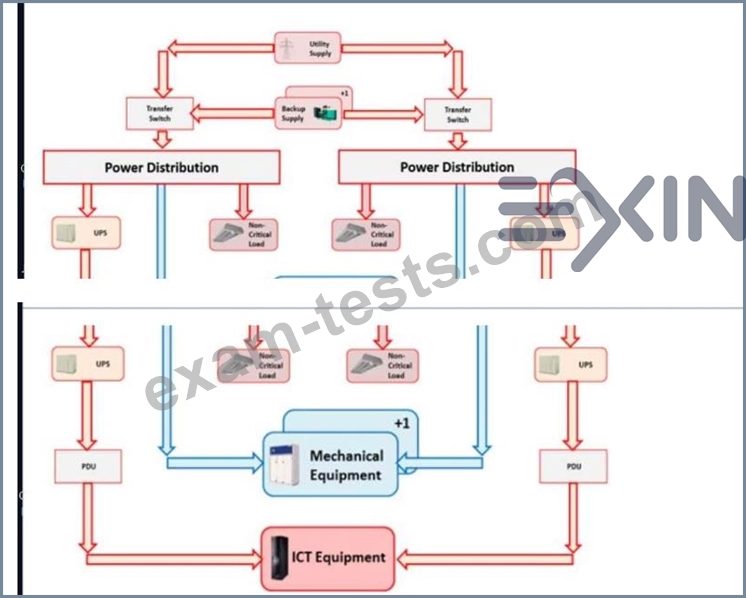
The logical overview of the data center looks as pictured. To what TIA-942 Rating is this design made based on electrical only?
Correct Answer: A
The electrical design shown in the diagrams represents a TIA-942 Rating-4 configuration. This design includes full redundancy and fault tolerance, as demonstrated by the dual power distribution paths from the utility supply to the critical loads. Each power distribution path is equipped with its own UPS, ensuring that the ICT equipment and mechanical equipment have uninterrupted power in case of any single point of failure. Detailed Explanation: A Rating-4 data center requires two independent power paths that are fully redundant and capable of supporting the load independently. In the diagrams: There are dual feeds from the utility supply, each going through separate transfer switches and power distribution paths. Both paths have backup sources (+1) and serve critical components through separate UPS systems, providing a completely redundant setup. The design also includes redundant paths to the mechanical equipment and ICT equipment, which further indicates the fault-tolerant characteristics of a Rating-4 infrastructure. This setup allows for concurrent maintainability and ensures that no single failure in power distribution or UPS can impact the data center's operation, which is characteristic of the highest Tier/Rated-4 classification. EPI Data Center Specialist References: EPI guidelines confirm that TIA-942 Rating-4 requires full redundancy and fault tolerance for electrical infrastructure, ensuring continuous operation even during maintenance or failure events. This design meets all those requirements, thus aligning with Rating-4 standards.