

Question 1
Context
It is always useful to look at the resources your applications are consuming in a cluster.
Task
* From the pods running in namespace cpu-stress , write the name only of the pod that is consuming the most CPU to file /opt/KDOBG030l/pod.txt, which has already been created.

Question 2
Refer to Exhibit.
Context
You have been tasked with scaling an existing deployment for availability, and creating a service to expose the deployment within your infrastructure.
Task
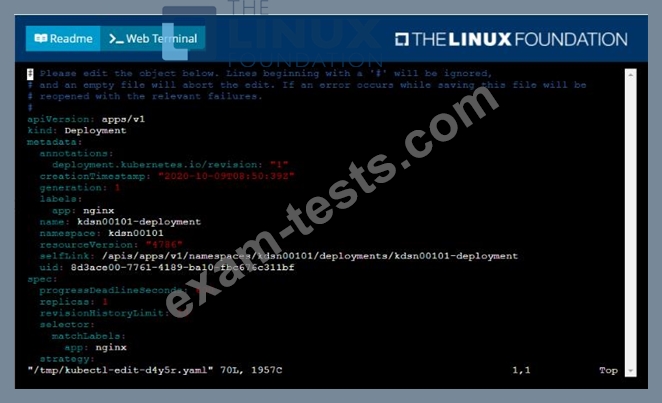
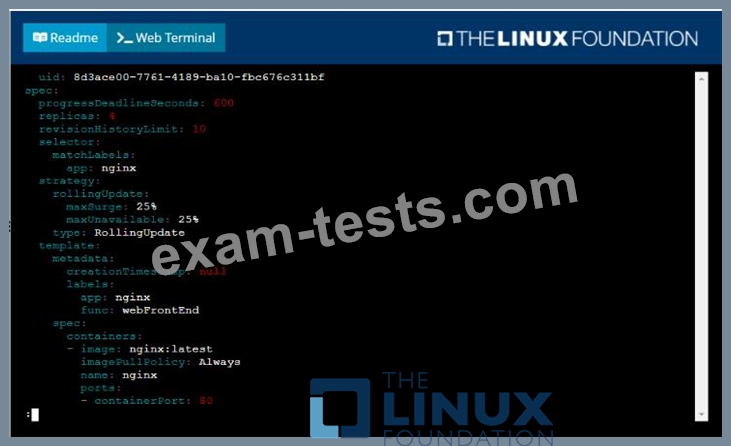
Start with the deployment named kdsn00101-deployment which has already been deployed to the namespace kdsn00101 . Edit it to:
* Add the func=webFrontEnd key/value label to the pod template metadata to identify the pod for the service definition
* Have 4 replicas
Next, create ana deploy in namespace kdsn00l01 a service that accomplishes the following:
* Exposes the service on TCP port 8080
* is mapped to me pods defined by the specification of kdsn00l01-deployment
* Is of type NodePort
* Has a name of cherry
Context
You have been tasked with scaling an existing deployment for availability, and creating a service to expose the deployment within your infrastructure.
Task
Start with the deployment named kdsn00101-deployment which has already been deployed to the namespace kdsn00101 . Edit it to:
* Add the func=webFrontEnd key/value label to the pod template metadata to identify the pod for the service definition
* Have 4 replicas
Next, create ana deploy in namespace kdsn00l01 a service that accomplishes the following:
* Exposes the service on TCP port 8080
* is mapped to me pods defined by the specification of kdsn00l01-deployment
* Is of type NodePort
* Has a name of cherry


Question 3
You are running a critical application on Kubernetes, and your security team has mandated the use of Pod Security Policies (PSPs) to enhance the security posture of your cluster. You have a Deployment that uses a privileged container for certain tasks. However, PSPs restrict the use of privileged containers. Describe how you can address this challenge while adhering to the security requirements imposed by PSPs.


Question 4
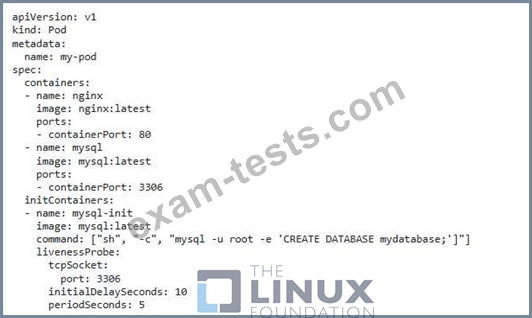
You have a multi-container Pod that runs a web server (Nginx) and a database (MySQL) container. The database container requires data to be initialized before the web server container can Stan. How would you configure the Pod to ensure the database container is initialized before tne web server container starts?
Question 5
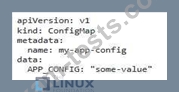
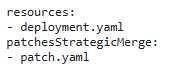
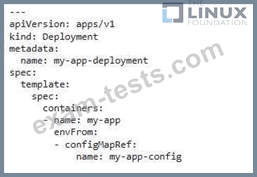
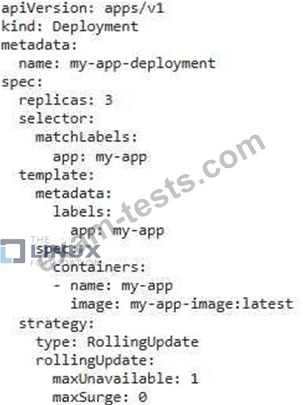
You have a Deployment named 'my-app-deployment' that runs 3 replicas of an application container. The application container requires access to a ConfigMap named 'my-app-config' . You want to configure your Deployment to use Kustomize to automatically update the ConfigMap's data within the containers whenever the ConfigMap is updated. You also need to configure a rolling update strategy for the Deployment that allows for a maximum of one pod to be unavailable during the update process.
Premium Bundle
Newest CKAD Exam PDF Dumps shared by BraindumpsPass.com for Helping Passing CKAD Exam! BraindumpsPass.com now offer the updated CKAD exam dumps, the BraindumpsPass.com CKAD exam questions have been updated and answers have been corrected get the latest BraindumpsPass.com CKAD pdf dumps with Exam Engine here: