A user new to Databricks is trying to troubleshoot long execution times for some pipeline logic they are working on. Presently, the user is executing code cell-by-cell, usingdisplay()calls to confirm code is producing the logically correct results as new transformations are added to an operation. To get a measure of average time to execute, the user is running each cell multiple times interactively. Which of the following adjustments will get a more accurate measure of how code is likely to perform in production?
Correct Answer: D
Explanation This is the correct answer because it explains which of the following adjustments will get a more accurate measure of how code is likely to perform in production. The adjustment is that calling display() forces a job to trigger, while many transformations will only add to the logical query plan; because of caching, repeated execution of the same logic does not provide meaningful results. When developing code in Databricks notebooks, one should be aware of how Spark handles transformations and actions. Transformations are operations that create a new DataFrame or Dataset from an existing one, such as filter, select, or join. Actions are operations that trigger a computation on a DataFrame or Dataset and return a result to the driver program or write it to storage, such as count, show, or save. Calling display() on a DataFrame or Dataset is also an action that triggers a computation and displays the result in a notebook cell. Spark uses lazy evaluation for transformations, which means that they are not executed until an action is called. Spark also uses caching to store intermediate results in memory or disk for faster access in subsequent actions. Therefore, calling display() forces a job to trigger, while many transformations will only add to the logical query plan; because of caching, repeated execution of the same logic does not provide meaningful results. To get a more accurate measure of how code is likely to perform in production, one should avoid calling display() too often or clear the cache before running each cell. Verified References: [Databricks Certified Data Engineer Professional], under "Spark Core" section; Databricks Documentation, under "Lazy evaluation" section; Databricks Documentation, under "Caching" section.
Question 47
The team has decided to take advantage of table properties to identify a business owner for each table, which of the following table DDL syntax allows you to populate a table property identifying the business owner of a table CREATE TABLE inventory (id INT, units FLOAT)
Correct Answer: B
Explanation CREATE TABLE inventory (id INT, units FLOAT) TBLPROPERTIES (business_owner = 'supply chain') Table properties and table options (Databricks SQL) | Databricks on AWS Alter table command can used to update the TBLPROPERTIES ALTER TABLE inventory SET TBLPROPERTIES(business_owner , 'operations')
Question 48
Which of the statements are incorrect when choosing between lakehouse and Datawarehouse?
Correct Answer: B
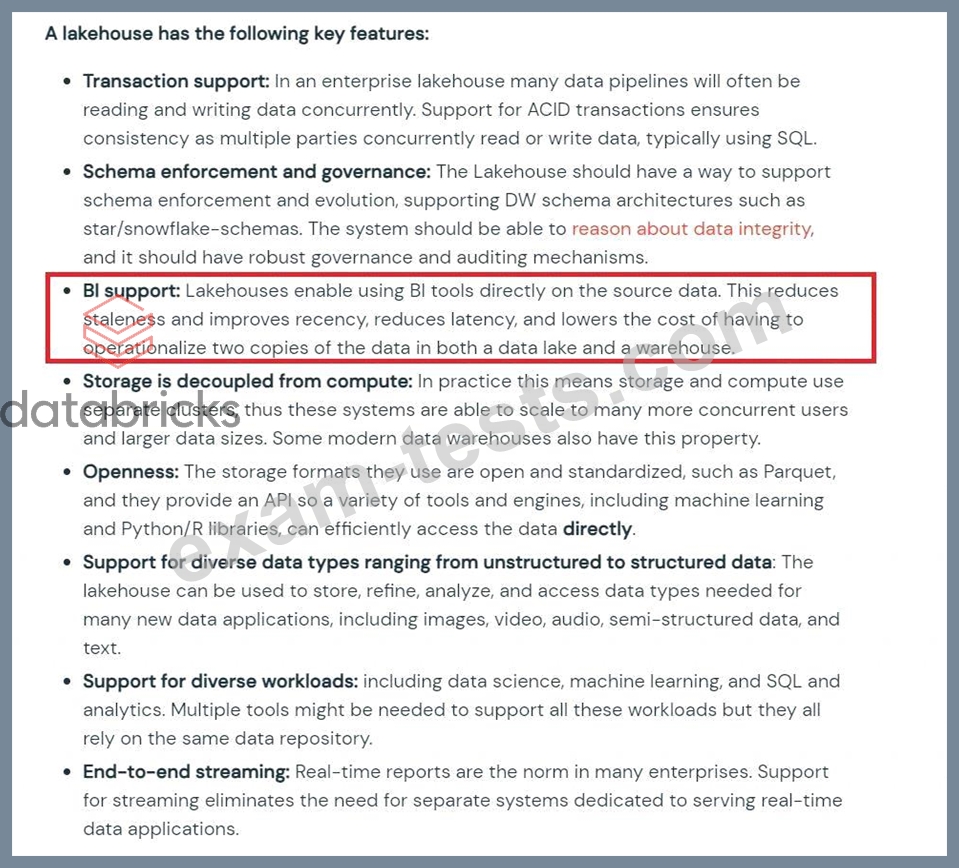
Explanation The answer is Lakehouse cannot serve low query latency with high reliability for BI workloads, only suitable for batch workloads. Lakehouse can replace traditional warehouses by leveraging storage and compute optimizations like caching to serve them with low query latency with high reliability. Focus on comparisons between Spark Cache vs Delta Cache. https://docs.databricks.com/delta/optimizations/delta-cache.html What Is a Lakehouse? - The Databricks Blog Graphical user interface, text, application Description automatically generated Bottom of Form Top of Form
Question 49
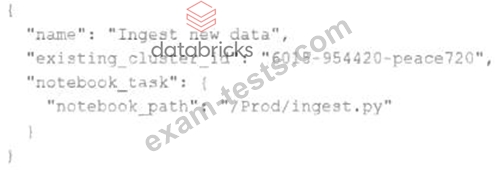
A junior data engineer has configured a workload that posts the following JSON to the Databricks REST API endpoint2.0/jobs/create. Assuming that all configurations and referenced resources are available, which statement describes the result of executing this workload three times?
Correct Answer: E
This is the correct answer because the JSON posted to the Databricks REST API endpoint 2.0/jobs/create defines a new job with a name, an existing cluster id, and a notebook task. However, it does not specify any schedule or trigger for the job execution. Therefore, three new jobs with the same name and configuration will be created in the workspace, but none of them will be executed until they are manually triggered or scheduled. Verified References: [Databricks Certified Data Engineer Professional], under "Monitoring & Logging" section; [Databricks Documentation], under "Jobs API - Create" section.
Question 50
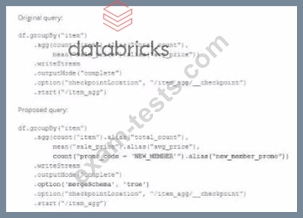
A data team's Structured Streaming job is configured to calculate running aggregates for item sales to update a downstream marketing dashboard. The marketing team has introduced a new field to track the number of times this promotion code is used for each item. A junior data engineer suggests updating the existing query as follows: Note that proposed changes are in bold. Which step must also be completed to put the proposed query into production?
Correct Answer: B
When introducing a new aggregation or a change in the logic of a Structured Streaming query, it is generally necessary to specify a new checkpoint location. This is because the checkpoint directory contains metadata about the offsets and the state of the aggregations of a streaming query. If the logic of the query changes, such as including a new aggregation field, the state information saved in the current checkpoint would not be compatible with the new logic, potentially leading to incorrect results or failures. Therefore, to accommodate the new field and ensure the streaming job has the correct starting point and state information for aggregations, a new checkpoint location should be specified. Reference: Databricks documentation on Structured Streaming: https://docs.databricks.com/spark/latest/structured-streaming/index.html Databricks documentation on streaming checkpoints: https://docs.databricks.com/spark/latest/structured-streaming/production.html#checkpointing