

Question 1
Which of the following statements, about the test reporting activities for a project adopting
an iterative lifecycle model with very short iterations (e.g. two weeks iterations), is correct?
K2 1 credit
an iterative lifecycle model with very short iterations (e.g. two weeks iterations), is correct?
K2 1 credit
Question 2
You tend to be conservative in your project estimations because you know how many things can go wrong and extend the schedule. You manager is not happy with your estimates and thinks you are being too negative with your numbers and not trying hard enough Which estimation method should you use to provide your manager with a positive' number while still also providing the number you think is more realistic?
Question 3
Based on the historical data of 5 past and similar projects, you have calculated these average numbers of defects detected in system testing.
- For each 10000 LOC (lines of code), 200 defects
- For each person-month of development team effort, 49 defects
You want to use this information to perform estimation for a new project.
The project manager tells you that he/she has estimated 20000 new LOC for this new project.
Four developers work for four months on this project before system testing.
During system testing, 797 defects are discovered.
Assume that the system test of this new project is using the same amount of work as spent in the past projects.
Based on this information only, which of the following statement is certainly true about this project?
- For each 10000 LOC (lines of code), 200 defects
- For each person-month of development team effort, 49 defects
You want to use this information to perform estimation for a new project.
The project manager tells you that he/she has estimated 20000 new LOC for this new project.
Four developers work for four months on this project before system testing.
During system testing, 797 defects are discovered.
Assume that the system test of this new project is using the same amount of work as spent in the past projects.
Based on this information only, which of the following statement is certainly true about this project?
Question 4
Consider the following skills assessment spreadsheet for your test team (consisting of four team members):
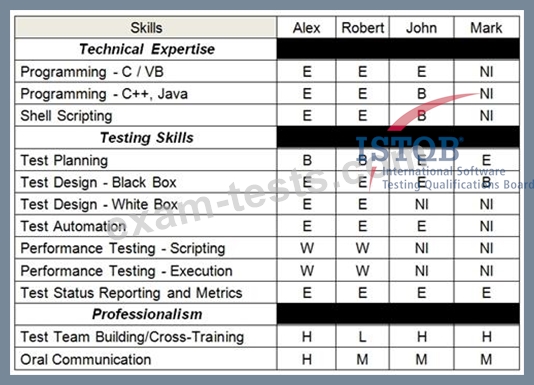
This spreadsheet has three sections: technical expertise, testing skills and professionalism.
The skill levels for each skill area for both the "technical expertise" and "testing skills" sections have been rated on a four-point scale:
- E (Expert): indicates that a person has expert knowledge and experience in the skill area
- B (Beginner): indicates that a person has some knowledge and experience in the skill area but he/she is not autonomous
- W (Wants to learn): indicates that a person has no knowledge or experience in the skill area but he/she wants to learn that skill
- NI (Not Interested): indicates that a person has no knowledge or experience in the skill area and he/she is not interested to learn that skill
The skill levels for each skill area of the "professionalism" section have been rated on a three point scale (H=High, M=Medium, L=Low).
You are using this skills assessment spreadsheet in order to define a training development plan for your test team.
Your objective is to fill the skill gaps by having at least a team member rated as an expert for each skill identified for the "technical expertise" and "testing skills" sections, and with the ability to train the other team members.
Considering the budget constraints you can send only one person to a training course.
Based only on the given information, which of the following answers would you expect to be the best option to achieve your objective?
This spreadsheet has three sections: technical expertise, testing skills and professionalism.
The skill levels for each skill area for both the "technical expertise" and "testing skills" sections have been rated on a four-point scale:
- E (Expert): indicates that a person has expert knowledge and experience in the skill area
- B (Beginner): indicates that a person has some knowledge and experience in the skill area but he/she is not autonomous
- W (Wants to learn): indicates that a person has no knowledge or experience in the skill area but he/she wants to learn that skill
- NI (Not Interested): indicates that a person has no knowledge or experience in the skill area and he/she is not interested to learn that skill
The skill levels for each skill area of the "professionalism" section have been rated on a three point scale (H=High, M=Medium, L=Low).
You are using this skills assessment spreadsheet in order to define a training development plan for your test team.
Your objective is to fill the skill gaps by having at least a team member rated as an expert for each skill identified for the "technical expertise" and "testing skills" sections, and with the ability to train the other team members.
Considering the budget constraints you can send only one person to a training course.
Based only on the given information, which of the following answers would you expect to be the best option to achieve your objective?
Question 5
You are the Test Manager on a project following an iterative life-cycle model. The project should consist of nine iterations of one month duration each. It is planned to develop the most important features to have a stable core of the application in the first three iterations and to add the additional features in the last six iterations.
At the beginning of the first iteration, only a draft version of the requirements specification document for the core features is available. Assume that during each of the first three iterations, the chosen features are fully completed and unit tested.
Which of the following statements is true in this context?
At the beginning of the first iteration, only a draft version of the requirements specification document for the core features is available. Assume that during each of the first three iterations, the chosen features are fully completed and unit tested.
Which of the following statements is true in this context?